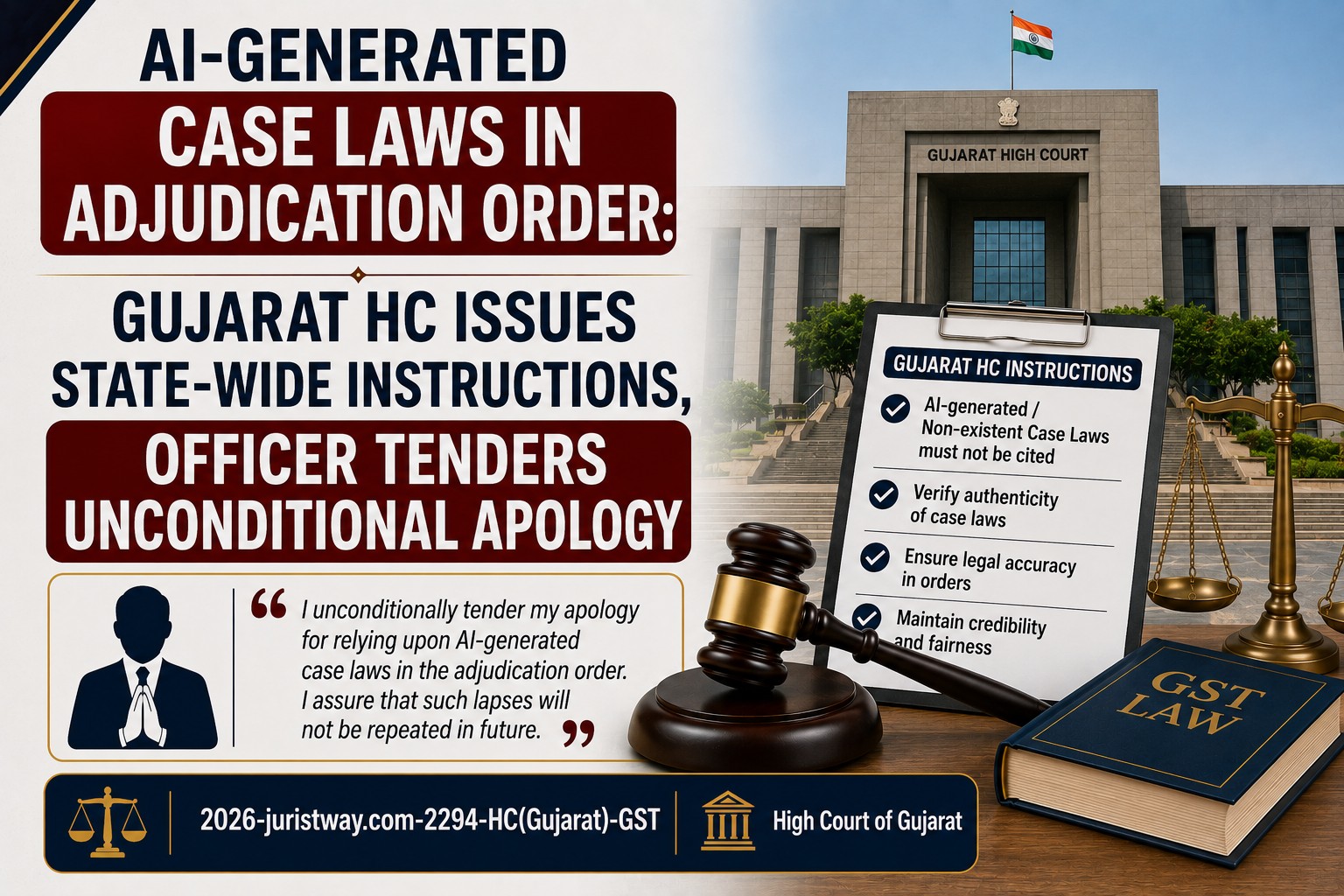
The Gujarat High Court has made permanent what began as an interim show cause in the Faiz Enterprise matter — issuing binding directions that AI-generated case law verification must accompany every adjudication and appeal order in the state, and accepting an unconditional apology from the State Tax Officer whose order had relied exclusively on non-existent and inapplicable AI-generated citations. The final order, by Justice A.S. Supehia and Justice Vaibhavi D. Nanavati in R/SCA No. 10123/2026 (decided 20.08.2026), takes the matter well beyond the individual dispute and converts it into a systemic discipline across Gujarat's GST adjudication infrastructure.
The background: on 13.08.2026, the court had noted that the impugned cancellation order passed by State Tax Officer Unit-67, Surat, had relied upon three case laws — one claimed to be from the Gujarat High Court (State of Gujarat v. Aarbee Structures Pvt. Ltd.) and two from other High Courts — none of which matched any verifiable citation or applied to the facts at hand. The court observed that the order appeared to have been passed by placing reliance exclusively on AI-generated case laws and directed the AGP to obtain instructions. It also threatened to summon the officer personally.
On the return date, the officer — a probationary officer, Shri Devang Arvindkumar Yadav — appeared personally before the court and filed an affidavit tendering an unconditional apology. He acknowledged using AI to source the citations without independent verification, attributed the error to lack of experience, and confirmed he had since attended a departmental training on AI usage in drafting. The Additional Commissioner of State Tax (Admin), Gujarat, had already issued instructions dated 18.08.2026 to all Joint Commissioners of State Tax in Divisions 1 to 12, framing a five-point protocol for AI use in adjudication: (i) all AI-sourced case laws and statutory provisions must be independently verified from primary official sources before use; (ii) citations must be accurate, relevant and current, with the original verbatim text reproduced, not a paraphrase; (iii) taxpayer citations must be considered and distinguished if inapplicable, with reasons recorded; (iv) AI use must be accompanied by human oversight given accuracy and transparency concerns; (v) orders must reflect independent legal reasoning — AI assists but cannot substitute it. Failure to comply would amount to misconduct attracting disciplinary action.
The court directed that these administrative instructions shall be treated as having the force of court directions — any violation will amount to contempt of the Gujarat High Court. The underlying impugned orders (cancellation, revocation rejection and appellate order) were quashed entirely, with directions to issue a fresh notice to the petitioner and pass a reasoned order after considering the petitioner's reply. The case is significant not only for its disciplinary dimension but because it is the first instance of a High Court formally institutionalising AI-governance requirements for quasi-judicial tax orders, with contempt as the enforcement mechanism.