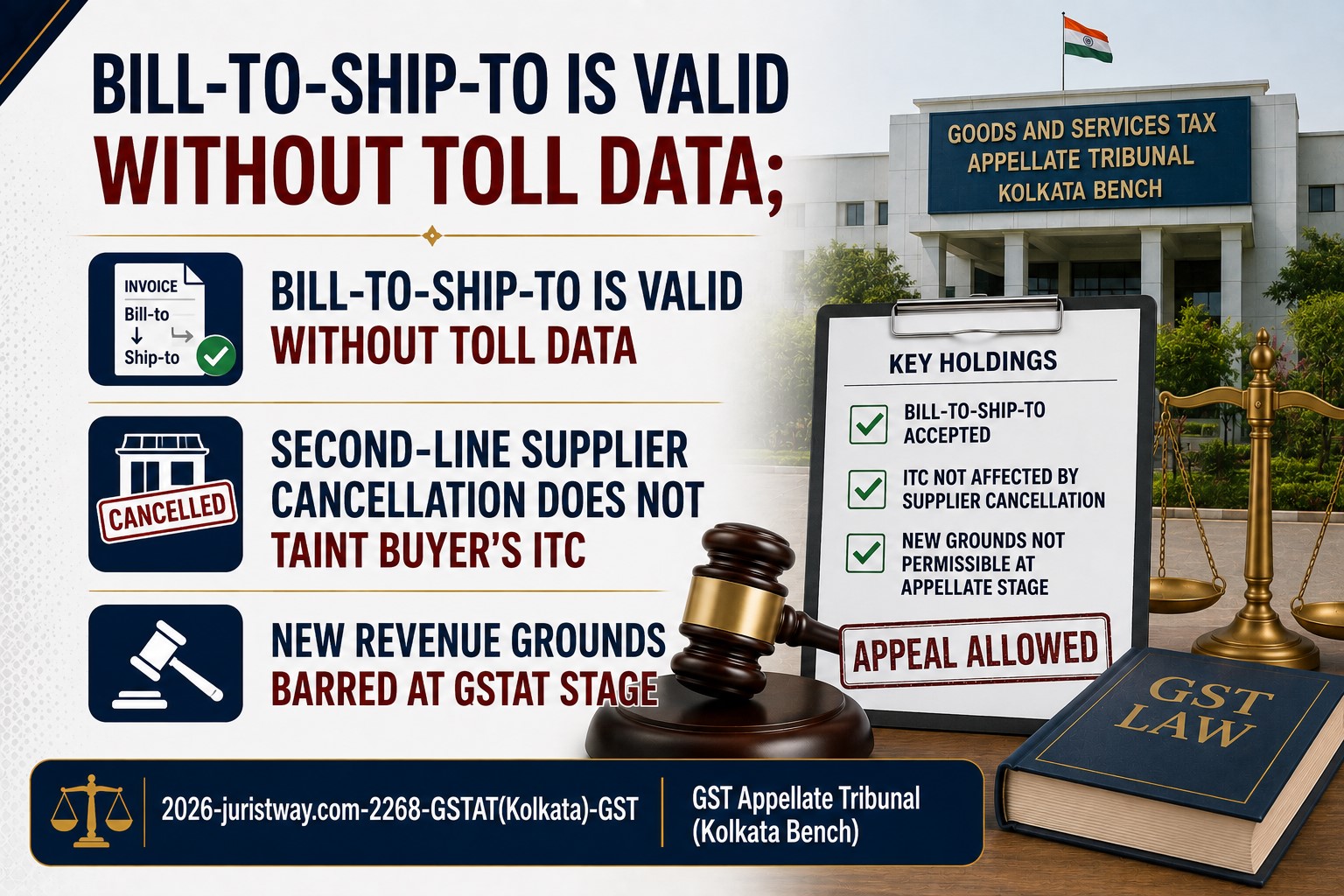
The GSTAT Kolkata Bench has dismissed Revenue appeals against ITC refund orders in favour of Agarwala's Bitumex Private Limited on three distinct grounds — each of independent significance for the GST trade and litigation community. In Final Orders in APL/14/KLK/2026 and APL/10/KLK/2026 (decided 20.08.2026), the Tribunal upheld the legitimacy of a Bill-to-Ship-to supply chain for exported bitumen, held that toll plaza data is not a statutory requirement for ITC or refund eligibility, rejected the Revenue's attempt to taint the buyer's ITC based on cancellation of second-line (level-2) suppliers, and applied Rule 45(1) of the newly framed GSTAT Procedure Rules 2025 to shut out entirely new grounds of challenge raised by the Revenue for the first time before the Tribunal.
The underlying facts involve the export of bitumen (VG-30) and iron and steel bars. Agarwala's Bitumex procured the bitumen from its direct supplier KS Metals Pvt. Ltd., a Kolkata-registered entity, under a Bill-to-Ship-to arrangement — meaning the invoice was raised by KS Metals but the goods were dispatched directly from a source outside West Bengal. The Revenue's primary ground of challenge was that FASTAG and toll data showed no vehicle movement through West Bengal, from which it sought to infer that no actual physical supply had occurred. The GSTAT rejected this inference. The Bill-to-Ship-to model is expressly recognised under the GST framework and permits dispatch from a location other than the supplier's registered state — the requirement is that the supply chain is documented through tax invoices, e-way bills, bilties (lorry receipts), shipping bills and export general manifests. All of these were present. The absence of West Bengal toll crossing was explained by the goods having moved directly from the point of origin outside Bengal; it is not a disqualifying factor.
On toll receipts specifically, the Tribunal applied and built upon the Allahabad High Court's ruling in Raghuvansh Agro Farms (2026 (38) Centax 53 (All.)) — which had held that toll plaza receipts are not a statutory condition for establishing actual movement of goods under the GST framework. Section 16 of the CGST Act sets out the conditions for ITC eligibility, and none of them requires toll receipts. E-way bills, bilties, tax invoices and banking evidence are the appropriate documentary trail, and where these are present, ITC cannot be denied solely because toll data does not match the expected route.
The second independent ground — that the direct supplier KS Metals had itself procured bitumen from level-2 suppliers whose registrations were subsequently found to be ab initio cancelled — was equally firmly rejected. The Tribunal applied the well-established principle that ITC taint due to supplier default only affects the immediate recipient if the recipient either knew of the fraud or participated in it. Here, KS Metals' own registration was never in dispute; only its level-2 suppliers were found to have invalid registrations. Agarwala's Bitumex, dealing at arm's length with a genuinely registered direct supplier and fulfilling all Section 16 conditions, cannot be penalised for irregularities two layers up the supply chain.
The most procedurally significant aspect of the ruling is the application of Rule 45(1) of the GSTAT (Procedure) Rules, 2025 to bar the Revenue's new grounds entirely. Before the GSTAT, the Revenue sought to introduce two completely new arguments: that Agarwala's Bitumex required a PESO (Petroleum and Explosives Safety Organisation) licence for bitumen trading which it lacked, and that a DGGI investigation was ongoing against it. Neither ground had been raised in the SCN, the OIO, or the first appellate order. Rule 45(1) of the GSTAT Procedure Rules 2025 provides that no additional evidence — oral or documentary — not placed before the adjudicating authority or first appellate authority can be produced before the Tribunal. The Tribunal applied this rule to shut out both new grounds at the threshold, without examining their merits. Rule 112(1) of the CGST Rules 2017 contains a parallel bar before appellate authorities. Together these rules establish a firm principle: Revenue (and taxpayer) attempts to introduce fresh factual grounds at the second appellate stage will fail.