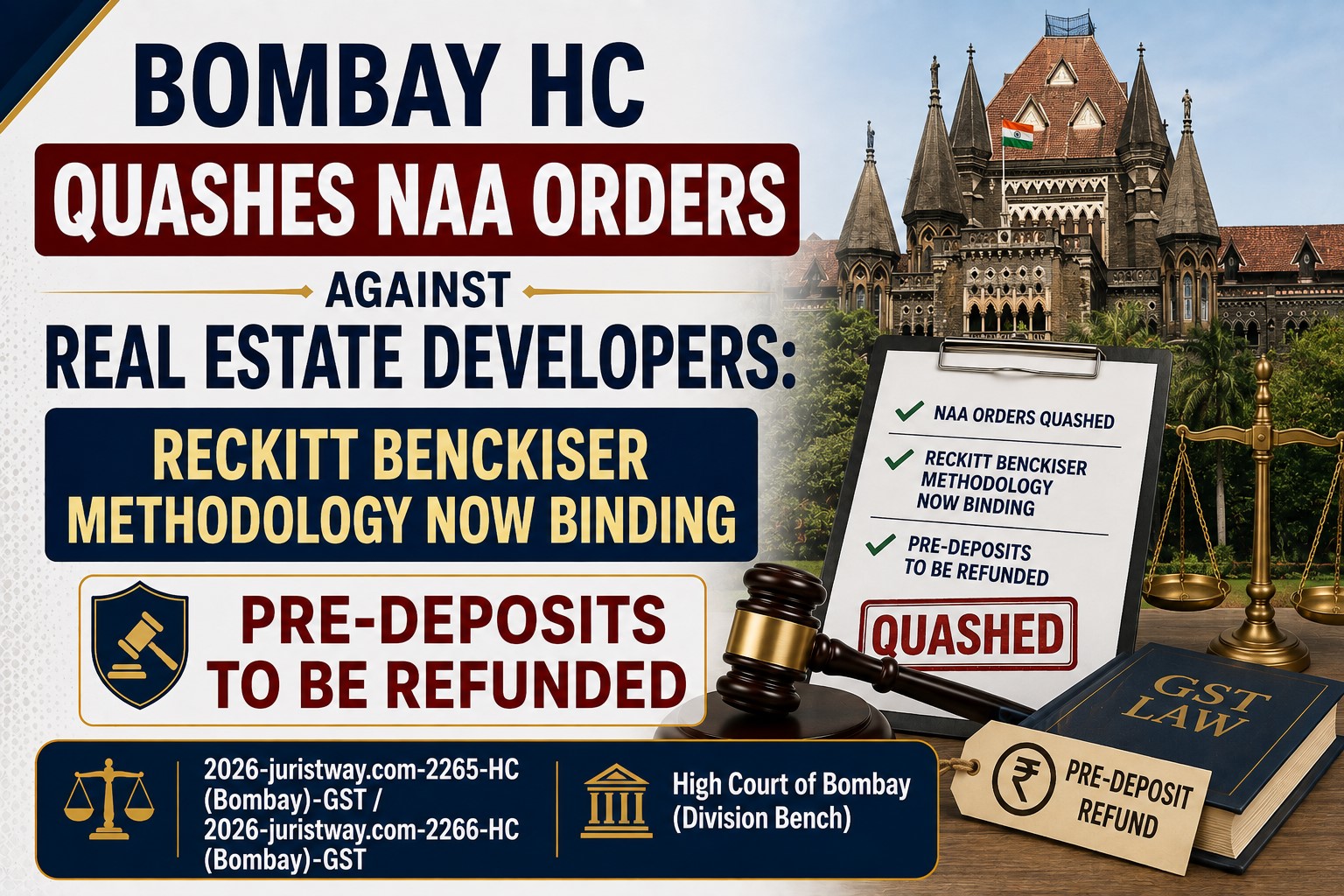
The Bombay High Court has quashed National Anti-Profiteering Authority orders against three real estate developers in two companion judgments decided on the same day, directing the GSTAT to recompute profiteering amounts using the per-square-foot methodology prescribed by the Delhi High Court in Reckitt Benckiser India Pvt. Ltd. v. Union of India (decided 29.01.2024). In the second judgment — concerning Elante Properties Private Limited and Omkar Realtors & Developers — the court additionally directed refund of 50% pre-deposits made by the petitioners pursuant to an earlier interim direction. The rulings complete the Bombay HC's alignment with the Delhi HC's position on the methodology for computing profiteering in the real estate sector.
At the heart of both cases is the DGAP's methodology for computing the profiteering amount. In real estate anti-profiteering investigations, the DGAP compares the ratio of Input Tax Credit to total turnover (purchase value) in the pre-GST period against the same ratio in the post-GST period, and treats the increase in that ratio as the measure of additional ITC benefit that should have been passed on. The Delhi High Court in Reckitt Benckiser found this approach fundamentally flawed for the real estate sector: the ITC-to-turnover ratio captures the project at an aggregate level but ignores the per-unit impact on individual buyers, resulting in profiteering computations that are inaccurate at the buyer level and inconsistent with Section 171's requirement of "commensurate reduction in prices." The correct approach, the Delhi HC held, is to compute the total ITC benefit for each project, divide it by the total saleable area to arrive at a per-square-foot benefit figure, and require the developer to pass on that per-square-foot amount to each buyer.
In the Sanghvi Premises writ petition (the first of the two judgments), the Revenue's counsel conceded on instructions that the matter ought to be remanded in light of the Reckitt Benckiser judgment. The Bombay HC accepted this concession, quashed the NAA's order dated 26.07.2022, and directed the GSTAT to recompute the profiteering amount on a per-square-foot project-wise basis. The vires challenge to Section 171 itself — arguing that the anti-profiteering provision is unconstitutional — was left open pending the Supreme Court's decision in SLP No. 012705/2024, in which the Revenue has challenged the Reckitt Benckiser judgment.
In the second judgment covering Elante Properties and Omkar Realtors, the same course was followed. The additional relief granted in this case is the direction to refund the 50% pre-deposit amounts along with interest, which the petitioners had made pursuant to an interim order dated 02.12.2024. Since the underlying orders have now been quashed entirely, the pre-deposits — made as a condition for staying the NAA's orders pending the writ proceedings — no longer have any basis and must be returned. For developers across the country whose NAA orders are pending at the GSTAT, these rulings signal that the per-square-foot recomputation methodology from Reckitt Benckiser is now the operative standard before the Tribunal, and that pre-deposits made in anti-profiteering proceedings will be refundable where the underlying order is quashed on remand.