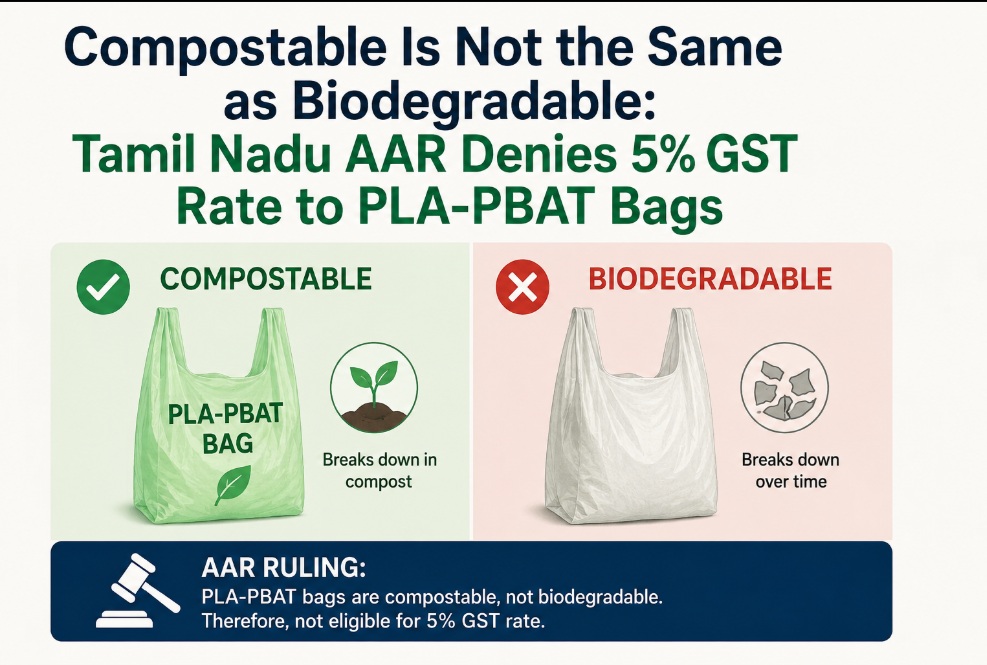
The Tamil Nadu Authority for Advance Ruling has delivered a closely reasoned ruling that will require the compostable packaging industry to take stock of its classification position: compostable bags certified under IS/ISO 17088 are not the same as biodegradable bags as defined under the Plastic Waste Management Rules, 2016, and accordingly do not qualify for the 5% GST rate introduced under Entry 319 of Notification No. 09/2025-Central Tax (Rate) with effect from 22.09.2025. The ruling was passed in the case of M/s Symphony Polymers Private Limited (TN/47/ARA/2026, 21.07.2026), a Chennai-based manufacturer of compostable bags made from a Poly Lactic Acid and Poly Butylene Adipate Terephthalate blend.
The background to the controversy lies in the 54th GST Council's decision to reduce GST on "Paper Sacks/Bags and bio-degradable bags" under Chapters 39 and 48 from 18% to 5%, effective 22.09.2025. Entry 319 in Schedule I of Notification 09/2025 gives effect to this reduction. The applicant — whose products are certified by both CIPET (under IS/ISO 17088, the compostable plastics standard) and the Central Pollution Control Board as conforming to the compostable carry bags criteria — argued that its compostable bags are biodegradable and should accordingly attract 5% GST. The Ministry of Environment's press release of March 2026 was also cited, which referred to the rate reduction as encouraging "over 200 certified compostable manufacturers to scale up production of starch-based and compostable materials."
The AAR ruled against the applicant on the strength of a critical definitional distinction embedded in the Plastic Waste Management Rules themselves. Rule 3 of the PWM Rules, as amended in 2022, defines "Biodegradable plastics" and "Compostable plastics" as two separate and mutually exclusive categories. Biodegradable plastics are those that degrade under ambient environmental conditions (in soil or water) in accordance with IS 17899 T:2022, and must be certified by the CPCB under that standard. Compostable plastics are those that degrade specifically under controlled composting conditions in accordance with IS/ISO 17088 — and this standard expressly excludes compostable plastics from the scope of IS 17899 T:2022. In short, all compostable plastics may be biodegradable in a colloquial sense, but they are not "biodegradable" within the statutory and regulatory framework that Entry 319 implicitly invokes.
The applicant held CPCB certification for compostable carry bags (IS/ISO 17088) but did not hold CPCB certification for biodegradable carry bags (IS 17899 T:2022). Since IS 17899 T expressly excludes compostable plastics from its scope, the applicant's products cannot simultaneously claim to be biodegradable under the PWM Rules framework. The AAR accordingly ruled that the supplies of compostable bags and packing materials are not covered by Entry 319 and attract GST at 18% as classified under Chapter Heading 3923 2990.
The ruling is significant for the industry because a large number of manufacturers of PLA/PBAT compostable bags — which dominate the certified compostable packaging market — are likely to have assumed that the 54th Council's rate reduction applied to their products. Manufacturers holding only IS/ISO 17088 / CPCB compostable certification who have been charging 5% GST since 22.09.2025 may be exposed to demands on the differential. Those who wish to bring their products within Entry 319 would need to separately obtain CPCB certification under IS 17899 T:2022 as biodegradable plastics — a distinct and more demanding certification pathway that compostable plastics cannot currently access since IS 17899 T excludes them from its scope. This creates a regulatory impasse that may require attention at the level of the GST Council or the CPCB's certification framework.