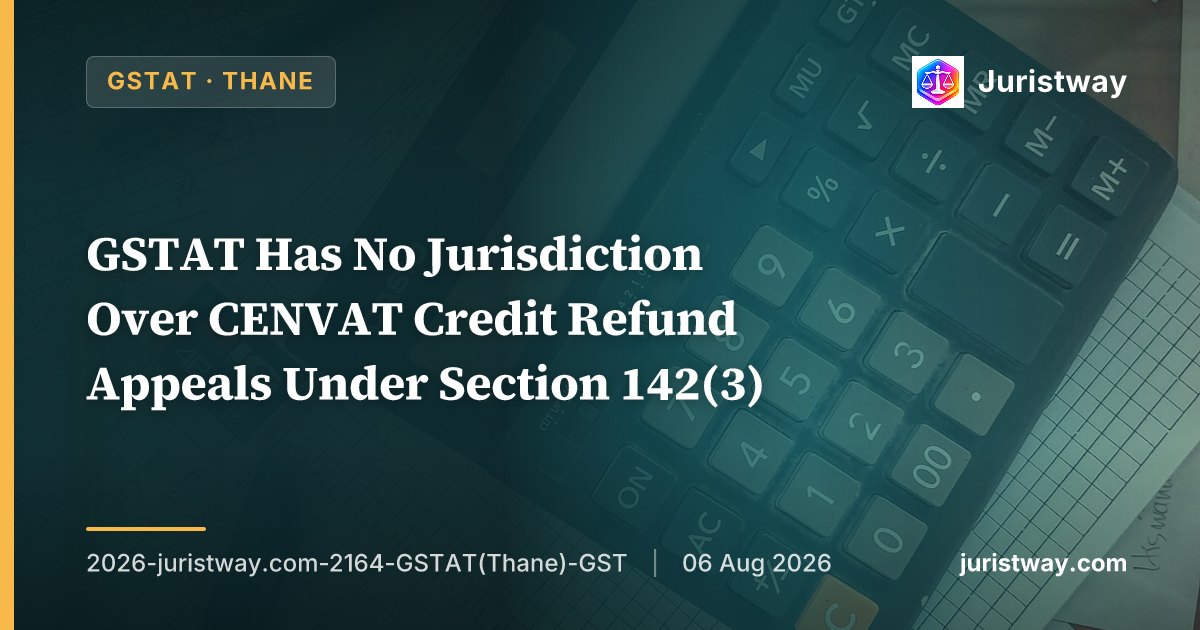
The GST Appellate Tribunal's Thane Bench has dismissed as not maintainable a Revenue appeal challenging a refund claim for unutilised CENVAT credit, holding that appeals arising from orders passed under Section 11B of the Central Excise Act, 1944 in respect of refund claims under Section 142(3) of the CGST Act must be filed before the Customs, Excise and Service Tax Appellate Tribunal — not before the GSTAT. The ruling, by Member (Judicial) Ramesh Nair and Member (Technical) Pralahad S. Paranjape in APL/3/THN/2026 (decided 06.08.2026), follows the CESTAT's own authoritative Larger Bench decision on this jurisdictional question.
The underlying dispute concerned Kairav Chemofarbe Industries Limited, which had claimed a cash refund of accumulated and unutilised CENVAT credit under Section 142(3) of the CGST Act, 2017. Section 142(3) governs the fate of refund claims filed before or after the appointed day (01.07.2017) in respect of amounts paid under the pre-GST regime. While section 142(3) is part of the CGST Act, it expressly provides that such refund claims "shall be disposed of in accordance with the provisions of existing law" — meaning the Central Excise Act, 1944 and specifically Section 11B thereof. Both the adjudicating authority and the first appellate authority had accordingly exercised jurisdiction under the Central Excise Act. The Revenue appealed to the GSTAT Thane Bench, arguing that because the refund claim invoked Section 142(3) of the CGST Act, the GSTAT had jurisdiction.
The Tribunal rejected this argument. The textual instruction in Section 142(3) — disposal "in accordance with the provisions of existing law" — means that the legal framework governing the proceeding, including the appellate hierarchy, is that of the pre-GST enactment. The CESTAT Larger Bench at Chennai had addressed exactly this question in M/s Bosch Electrical Drive India Pvt. Ltd. v. Commissioner of Central Tax, Chennai (2024 (390) ELT 652 (Tri.-LB)) and held that appeals against refund or credit rejection orders passed under Section 142(3) lie before the CESTAT, not the GSTAT. The Thane Bench applied this ruling and dismissed the Revenue's appeal as not maintainable, with liberty to approach CESTAT.
The ruling is relevant for practitioners navigating the currently unsettled jurisdictional terrain between GSTAT and CESTAT in transitional credit and legacy refund matters. Where the underlying order was passed under a pre-GST enactment — even if the statutory trigger is a provision of the CGST Act — the appellate forum is CESTAT. Advisories filed with GSTAT in such matters will need to be re-routed promptly, bearing in mind the limitation period applicable before CESTAT.