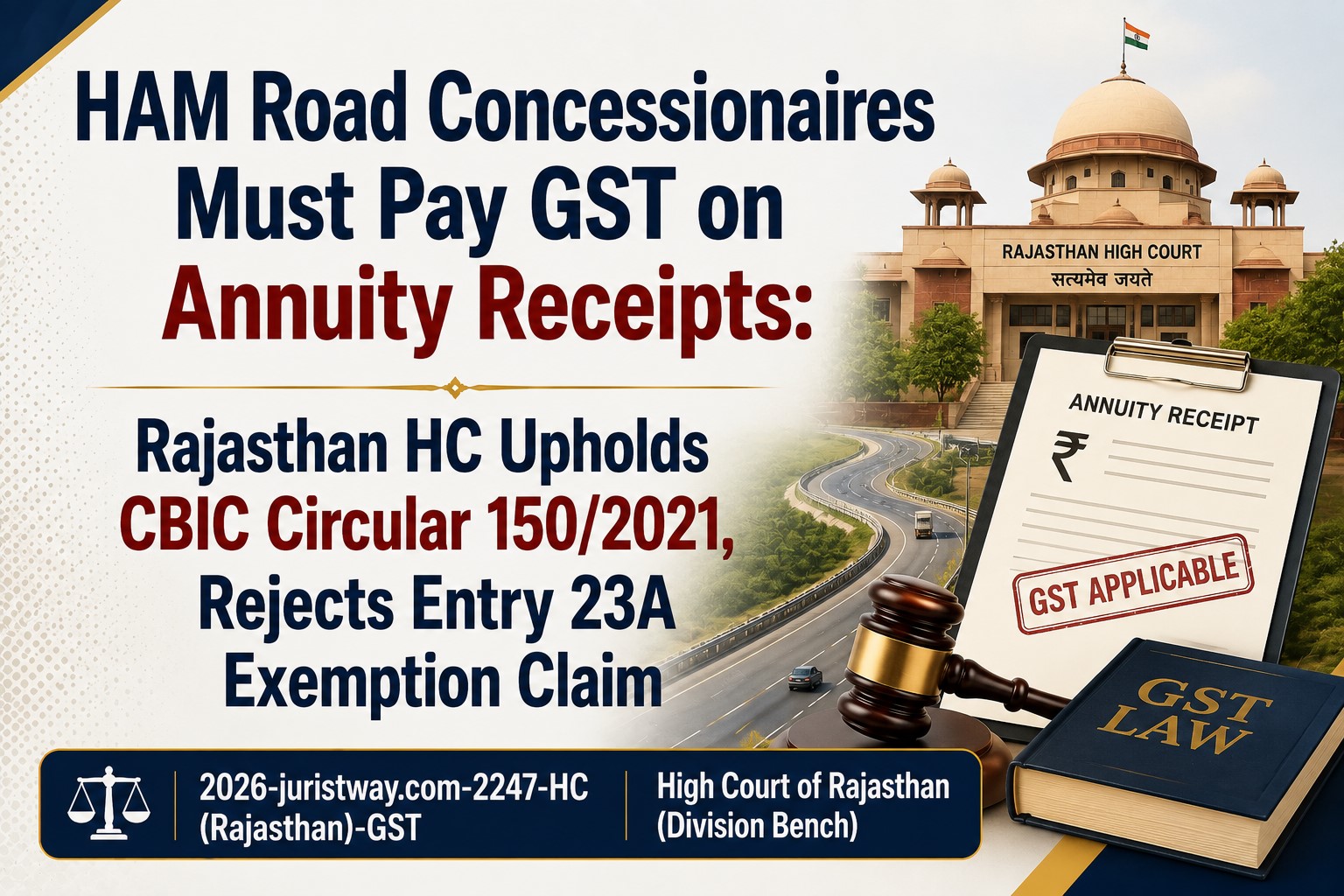
The Rajasthan High Court Division Bench has dismissed writ petitions by road concessionaires operating under Hybrid Annuity Model (HAM) contracts with NHAI, affirming that the annuity payments they receive for construction and development of national highways constitute taxable consideration for works contract services under Heading 9954 of the GST service classification — and do not attract the NIL exemption under Entry 23A of Notification No. 12/2017-Central Tax (Rate), which covers only access-to-road services under Heading 9967. The ruling in M/s Nagaur Mukundgarh Highways Pvt. Ltd. v. Central Board of Indirect Taxes and Customs (D.B. Civil Writ Petition No. 10055/2024 and five connected petitions, decided 17.08.2026) follows a coordinate bench ruling in CG Tollway Ltd. (decided 22.05.2026) and consolidates the Rajasthan High Court's position in line with the Meghalaya High Court's earlier ruling in Jorabat Shillong Expressway.
The HAM model, introduced by NHAI for highway development, splits the project cost between upfront milestone-based payments (50%) and deferred biannual annuity payments over ten years (50%). Concessionaires argued that the annuity payments fell within Entry 23A — inserted by Notification No. 27/2018-CT(R) — which exempts "service by way of access to a road or a bridge on payment of annuity" under Heading 9967. The argument was straightforward: the payments are annuities, the services relate to roads, and Entry 23A says "annuity" — so the exemption should apply. The Revenue's response was equally clear: Entry 23A was designed for toll-substitute arrangements where a user accesses an existing road in exchange for periodic payments; it was not designed to exempt the construction services themselves, which fall under Heading 9954 regardless of whether the consideration is structured as a lump sum or as a deferred annuity stream.
The court upheld CBIC Circular No. 150/06/2021-GST, which had expressly clarified this distinction: the circular states that Entry 23A covers only Heading 9967 (supporting services in transport — access to road) and not Heading 9954 (construction of roads), and that GST is accordingly payable on annuity receipts by road construction concessionaires. The petitioners challenged the circular as going beyond its permissible clarificatory role and as inconsistent with the text of Entry 23A. The court rejected this challenge, holding that CBIC circulars issued under Section 168 of the CGST Act are valid binding instructions to departmental officers, that the circular correctly identified the service being supplied by a HAM concessionaire as construction (not access), and that the principle of strict construction of exemption notifications (as settled by the Supreme Court in Commissioner of Customs v. Dilip Kumar & Company and affirmed in Safari Retreats) resolved any textual ambiguity in favour of the Revenue.
The Telangana High Court Single Bench ruling in GMR Pochanpalli Expressways (2024), which had struck down the CBIC circular, was specifically distinguished: it had not had the benefit of the Supreme Court's subsequent clarification in Safari Retreats on strict construction, and had proceeded on an analysis that the Rajasthan bench found unpersuasive. HAM concessionaires currently receiving annuity payments without discharging GST face a substantial retrospective exposure — both for the annuity instalments already received and for those due over the remaining tenure of their concession agreements. The GST indemnification clauses in their concession agreements with NHAI become critical in determining who ultimately bears this tax cost.