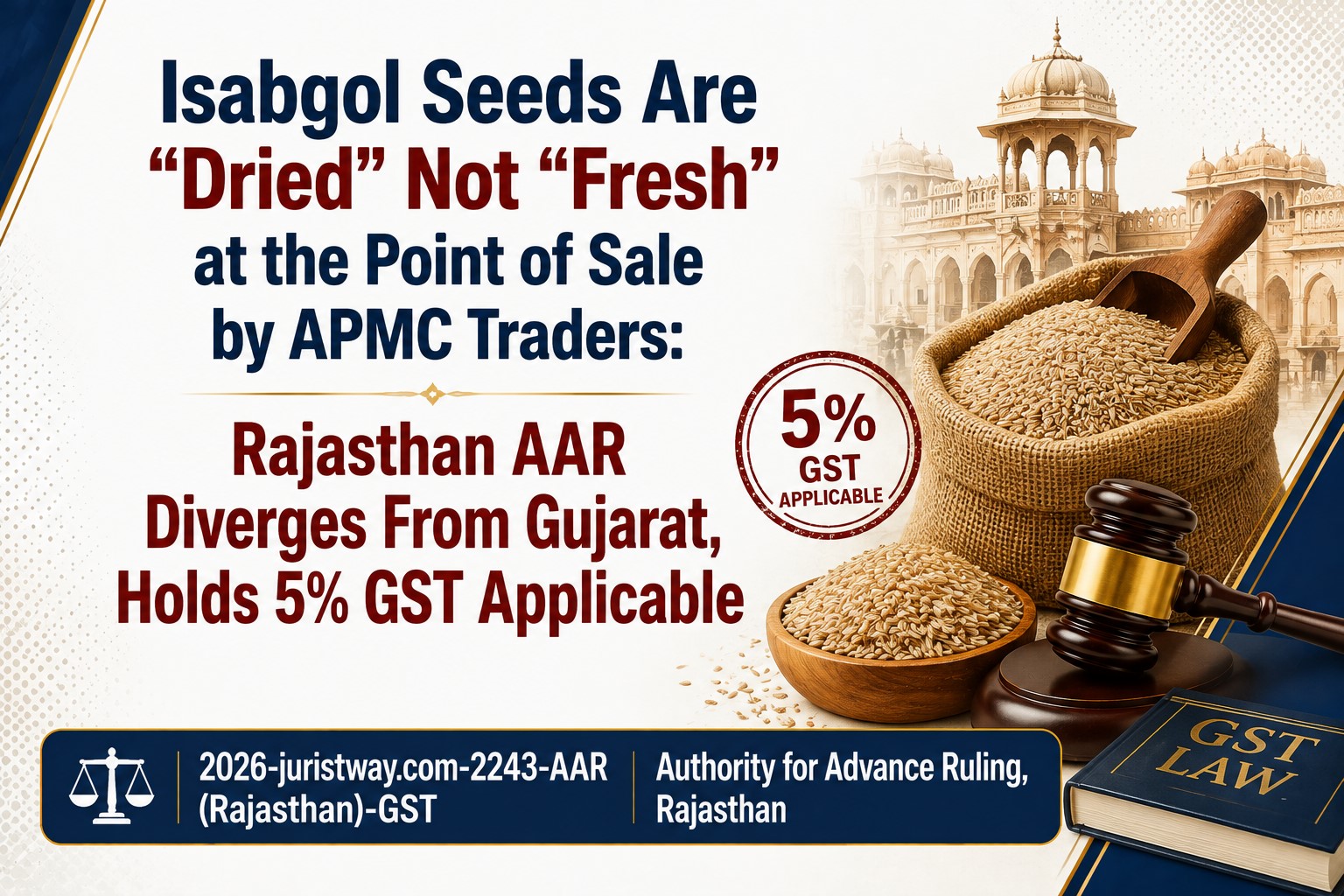
The Rajasthan Authority for Advance Ruling has ruled that Psyllium seeds (Isabgol) purchased by an APMC-licensed trader from farmers and supplied without any processing to Isabgol processing units attract GST at 5% — not NIL — because by the time of supply the seeds have acquired a "dried" character through storage in dry ventilated godowns, even in the absence of any intentional drying process. The ruling in In Re: M/s Surendra Bucha (RAJ/AAR/2026-27/03, decided 27.07.2026) directly conflicts with the Gujarat AAR's contrary ruling on identical facts issued in May 2026, creating an inter-state divergence that is likely to require resolution at the appellate or council level.
The applicant operates as an APMC-licensed agent-cum-trader in Rajasthan, purchasing Psyllium seeds from farmers through APMC auctions and supplying them without any processing — no washing, hulling, grading or deliberate drying — to downstream processing units that manufacture Isabgol husk. The seeds are stored in dry ventilated godowns pending supply. The applicant sought a ruling that these seeds, being plants or parts of plants used in pharmacy falling under HSN Heading 1211, qualify as "fresh or chilled" and therefore attract NIL GST under Entry 87 of Notification No. 10/2025-Central Tax (Rate). Alternatively, the applicant argued that all goods of seed quality under Chapter 12 are NIL-rated under Entry 77 of the same notification.
The AAR rejected both claims. On the "fresh or chilled" question, the Authority relied on CBIC Circular No. 163/19/2021-GST which had addressed an analogous issue in the context of fresh fruits and nuts — clarifying that "fresh" means supplied in the state as plucked from the plant, and that produce does not remain "fresh" after intentional drying including through sun drying, evaporation or freezing. The Rajasthan AAR applied this reasoning by analogy to Psyllium seeds: storage in dry ventilated godowns, while not a deliberate industrial drying process, nonetheless imparts a dried character to the seeds by the time of supply. The critical distinction the AAR drew is that the governing question is the condition of the goods at the time of supply by the applicant — not at the time of harvest from the field — and at that point the seeds have already lost the "fresh" character they may have had immediately after harvest. The NIL rate under Entry 87 is therefore unavailable. On the seed quality exemption under Entry 77, the AAR held that the specific entry for Psyllium seeds under HSN 1211 as dried — 5% under Entry 71 of Notification No. 09/2025 — governs over the general Chapter 12 seed entry, applying the principle that a specific entry prevails over a general one.
The CBIC's own FAQ (December 2017) had stated this position clearly: fresh Isabgol seeds are NIL; dried Isabgol seeds are 5%; Isabgol husk is 5%. The Rajasthan AAR treats storage in godowns — even without deliberate drying — as sufficient to move seeds from the fresh to the dried category at the point of the trader's supply. The Gujarat AAR reached the opposite conclusion on essentially similar facts in Jigneshkumar Narayandas Patel (Akshar Traders) (May 2026), treating such seeds as still "fresh" because no processing had been carried out. Rajasthan-based APMC traders and intermediaries in the Isabgol supply chain must now account for 5% GST on their sales. Until the divergence is resolved — whether through the Appellate AAR, the GST Council or a High Court — traders straddling both states face an uneven compliance landscape. The CBIC may need to issue a fresh clarification on what storage conditions are sufficient to convert "fresh" produce into "dried" produce for the purpose of the rate notifications.