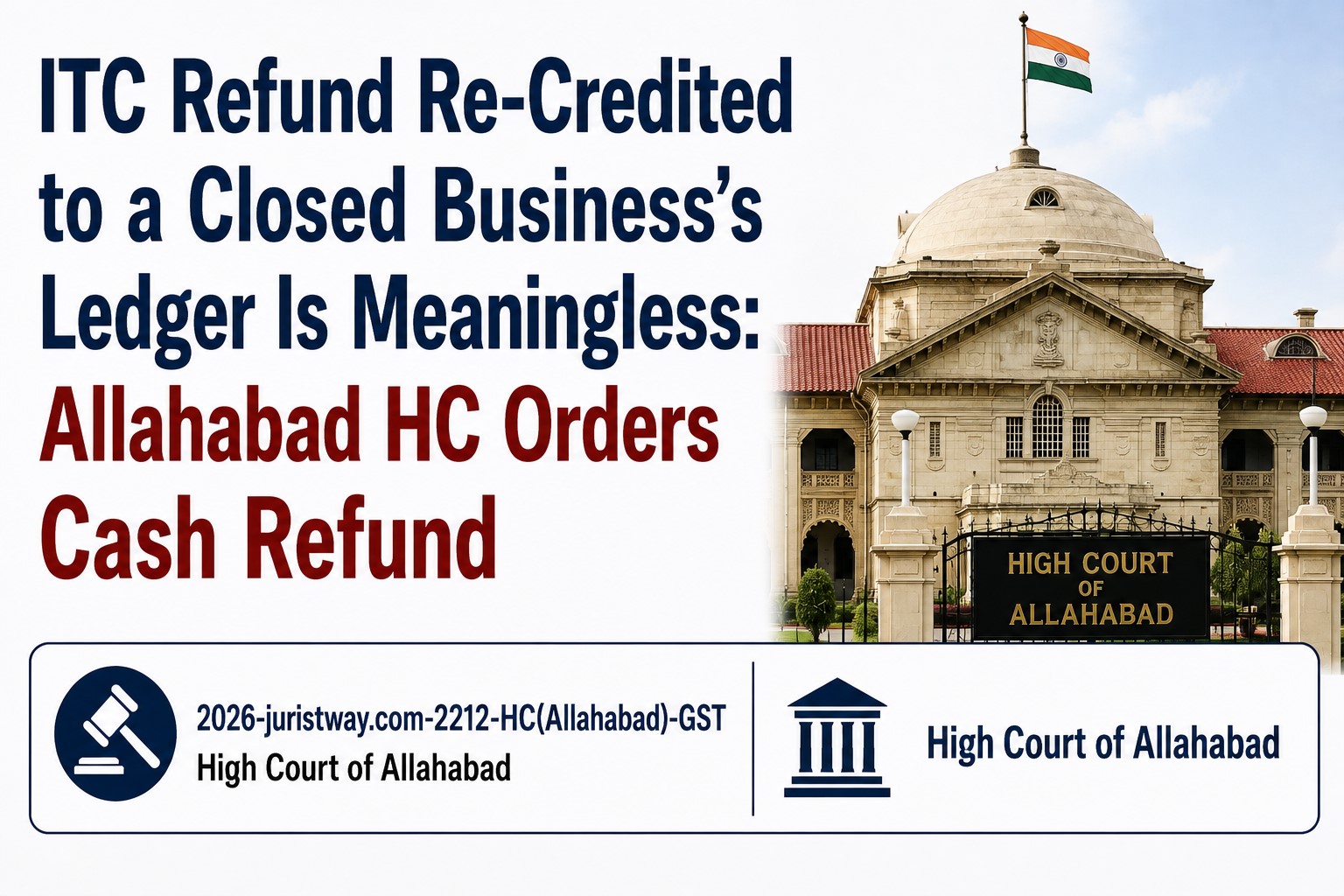
The Allahabad High Court has directed that a GST refund amounting to ₹1.10 crore be paid in cash to a company that has permanently discontinued business and surrendered its GST registration, holding that crediting the amount to a closed company's Electronic Credit Ledger — as the Revenue had done — confers no real or substantive benefit and is effectively meaningless. The ruling, by Justice Shekhar B. Saraf and Justice Abdhesh Kumar Chaudhary in Writ Tax No. 1014 of 2026 (M/s Vossloh Cogifer Turnouts India Pvt. Ltd., decided 10.08.2026), addresses a structural anomaly in the refund regime that would otherwise leave a wound-up business permanently unable to access its own money.
The petitioner had applied for a refund of Input Tax Credit under the inverted duty structure. The refund application was allowed by the adjudicating authority on 06.05.2026 for a total of ₹1.38 crore. Of this amount, a portion (approximately ₹28 lakh) was paid directly in cash to the petitioner's bank account, while the larger balance of ₹1.10 crore was directed to be re-credited to the Electronic Credit Ledger. The difficulty is that the petitioner had permanently discontinued business operations and had also surrendered its GST registration. With no active registration and no business to continue, the Electronic Credit Ledger had effectively ceased to function — and with it, the ability to utilise any credit sitting in that ledger.
The court found that the direction to re-credit the amount to the ECL of a company with no active registration or business was wholly impractical and was in conflict with the purpose of the refund regime, which exists to restore to taxpayers money to which they are entitled. The CGST Act does not prohibit payment of the refund amount in cash where the credit re-credit route has become non-functional. The court applied the restitutionary logic implicit in the refund provisions: refund means actual restoration of funds to the taxpayer, not a bookkeeping entry in an account the taxpayer can no longer access.
The Revenue was directed to refund the sum of ₹1.10 crore in cash to the petitioner's bank account, along with applicable interest if any under the provisions of the Act, within eight weeks. The court also noted that a separate challenge — to the Revenue's denial of Section 56 interest on the entire refund amount — was left open. The ruling is practically significant for any company that closes down after making a refund application, or that receives an adverse refund order directing re-credit of an amount to an ECL that is no longer operational.