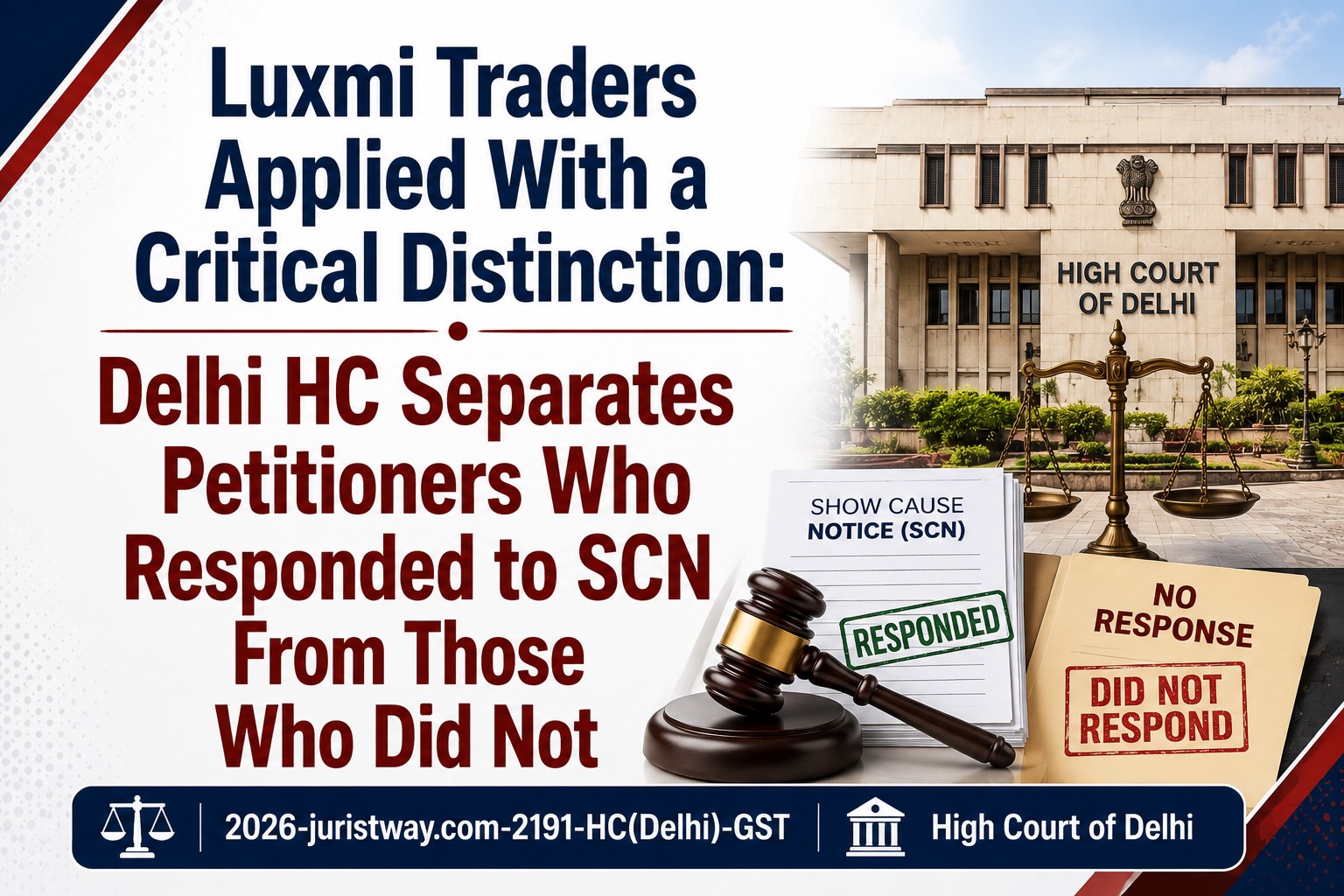
The Delhi High Court has applied the Punjab & Haryana High Court's Luxmi Traders ruling to two writ petitions but in materially different ways — and in doing so has drawn out a distinction that practitioners need to understand clearly: the relief available under Luxmi Traders depends on whether the taxpayer responded to the SCN or not, not simply on whether service was through the GST Common Portal's "Additional Notices and Orders" tab.
The two petitions — W.P.(C) 10640/2025 (Saraswati Printers) and W.P.(C) 10724/2025 (Fabgar Overseas Private Limited) — had originally been filed to challenge the constitutional validity of Notification No. 40/2021-Central Tax dated 29.12.2021 and a corresponding Delhi State notification, on the ground that these notifications (which designated the GST Common Portal) were ultra vires Section 164 of the CGST Act. That challenge was pressed no further once the Luxmi Traders judgment was brought to the court's attention. The petitioners' counsel withdrew the challenge to the notifications and sought disposal in terms of Luxmi Traders — but the factual situations of the two petitioners were not identical.
In the Saraswati Printers case, the SCN dated 27.11.2024 had been uploaded on the portal — but the petitioner had filed a reply to that SCN. By responding to the SCN, the petitioner had acknowledged its receipt and participated in the adjudication proceedings. The Delhi HC applied Luxmi Traders' paragraph 60 precisely here: where the SCN has been responded to, the portal-upload service objection to the SCN cannot be used to set aside the entire proceeding. However, the demand order dated 27.02.2025 was served only through the portal. Under Luxmi Traders paragraph 60(iii), where the order-in-original is served only on the portal, the limitation period for filing an appeal is not triggered. Saraswati Printers was accordingly given four weeks to file a statutory appeal against the demand order, which is to be entertained without any limitation objection.
In the Fabgar case, both the SCN (20.11.2024) and the demand order were uploaded on the portal and no reply was filed. This brought it squarely within Luxmi Traders paragraph 60(ii): ex parte adjudication where the SCN was only portal-served and no reply was filed. The demand order was set aside and proceedings restored to the SCN stage; Fabgar was given four weeks to file its reply.
The ruling is a useful operational guide on how Luxmi Traders interacts with different procedural fact patterns within the same case. It confirms that the Luxmi Traders principles are not a blanket reset button for all portal-service cases — their precise application depends on what happened after the portal-upload. Where a taxpayer responded, the adjudication cannot be unwound merely because the OIO was portal-served; the taxpayer gets a fresh limitation window for appeal. Where neither SCN nor OIO was responded to, the entire adjudication is set aside and proceedings begin again at the SCN stage.