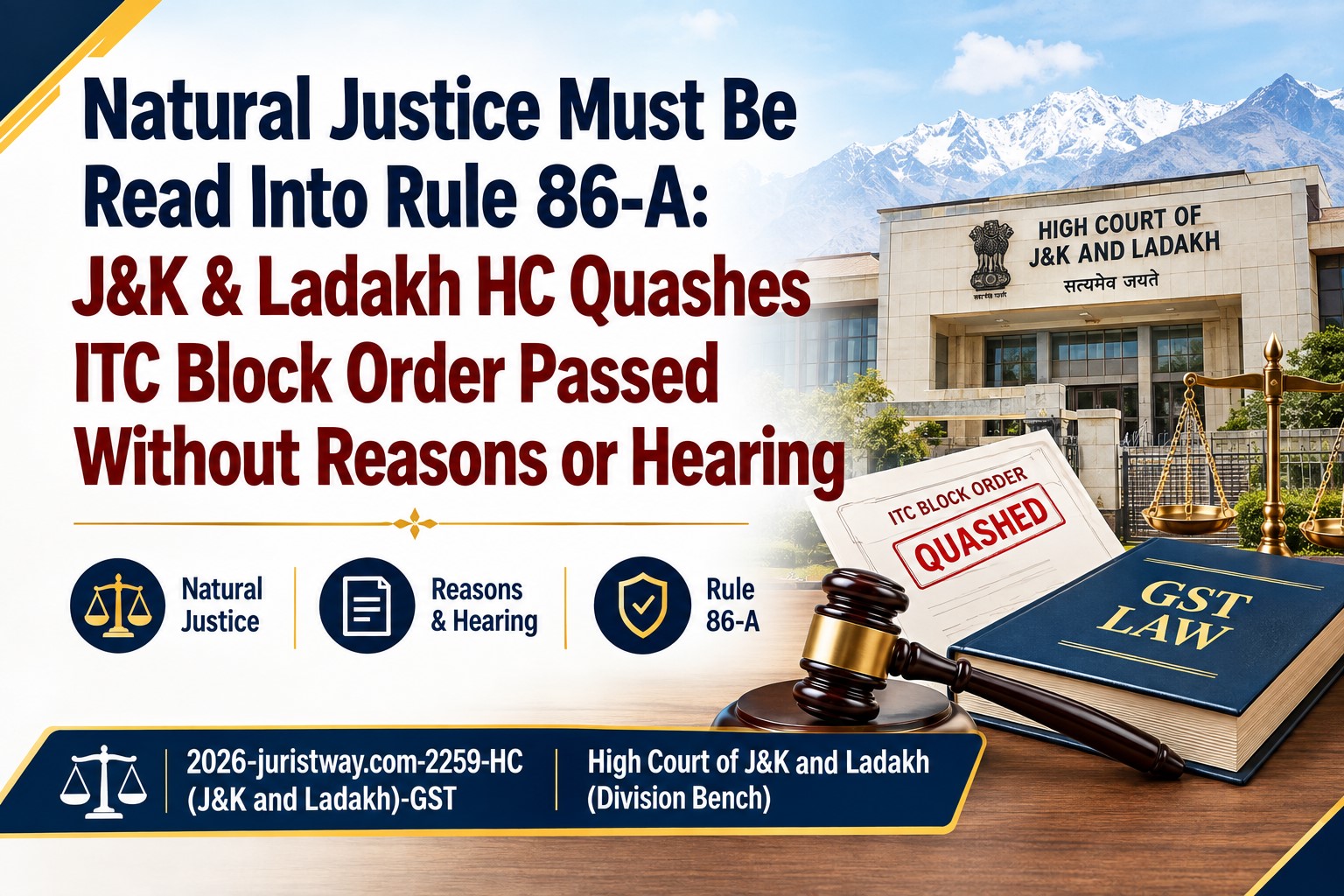
The High Court of J&K and Ladakh has quashed a communication blocking Rs. 10.45 crores of Input Tax Credit of NCC Limited under Rule 86-A of the CGST Rules, holding that the audi alteram partem rule must be read into the provision even though Rule 86-A does not expressly mandate a pre-order hearing, and that the blocking communication was independently vitiated by its complete absence of reasons. The ruling, by a Division Bench in WP(C) 1935/2026 (decided 12.08.2026), aligns with a growing body of authority from Karnataka, Telangana and other courts on the procedural requirements for ITC blocking under Rule 86-A.
Rule 86-A enables a Commissioner, on reasons to believe that ITC has been fraudulently availed or is ineligible, to block the use of that credit in the Electronic Credit Ledger. The provision on its face does not provide for a hearing before the blocking order is passed — a deliberate omission, Revenue commonly argues, given the urgent preventive character of the measure. NCC Limited, a construction company, received a communication dated 22.07.2026 from the Additional Commissioner, State Tax, Kashmir directing block of Rs. 10,45,38,432 of ITC with no reasons assigned. No notice was issued, no opportunity of hearing was afforded, and the communication provided no basis from which NCC could understand why its credit had been targeted.
The court followed the Karnataka High Court Division Bench in K-9 Enterprises v. State of Karnataka (2024 SCC Online Kar 2716) — a ruling subsequently affirmed by the Supreme Court on dismissal of the Revenue's SLP — and the Telangana High Court Division Bench in Bhavani Oxides and Others v. State of Telangana (2024 SCC Online TS 3306). Both courts had held that even where a statute is silent on the requirement of pre-order hearing, the principles of natural justice must be read in when the order occasions severe adverse civil consequences on the affected party. An ITC block of Rs. 10 crores squarely qualifies: it paralyses the taxpayer's ability to discharge GST liabilities and disrupts business operations.
The court also held the communication independently unsustainable for absence of reasons. Rule 86-A requires the Commissioner to have "reasons to believe" — the provision imports a requirement that the reasons are documented and communicated so the affected party can understand the basis of action and seek appropriate remedy. A bare direction to block, with no reasons assigned, does not satisfy this threshold. The blocking communication was accordingly quashed. The competent authority retains liberty to pass a fresh order under Rule 86-A, but must first afford NCC an adequate opportunity of hearing and must record reasons for the action.