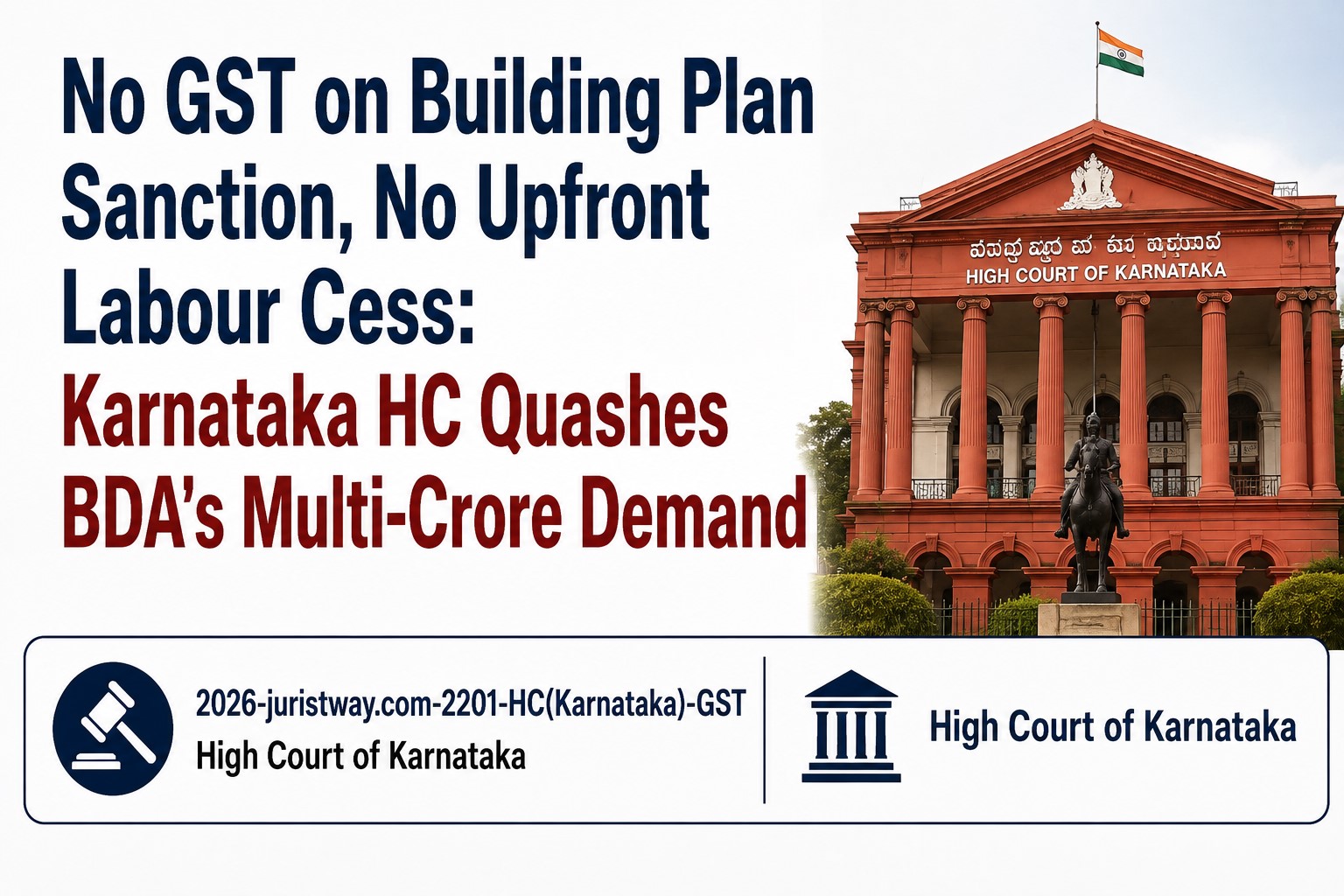
The Karnataka High Court has quashed major components of a ₹4.43 crore demand by the Bangalore Development Authority against a real estate developer — including scrutiny fee, ground rent and security deposit — and has specifically held that the BDA has no authority to collect CGST and SGST on the sanction of a building plan because there is no supply of goods or provision of services involved in plan sanctioning. The ruling, by Justice R. Nataraj in Writ Petition No. 5188 of 2022 (BDA) (decided 21.07.2026), reinforces a consistent Karnataka High Court line against excessive municipal levies and adds GST as a fresh ground of challenge.
The petitioners were developers of a multistoried complex in Seegehalli village, Bengaluru East, who received a demand notice from the BDA's Technical Advisor requiring payment of ₹4.43 crore comprising scrutiny fee (₹81.40 lakh), ground rent (₹1.03 crore), development fee (₹6.29 lakh), plan paper fee (₹64,000), CGST and SGST at 9% each (₹17.23 lakh each), labour welfare fund (₹1.26 crore), and security deposit (₹90.45 lakh). The demand was premised on a BDA Circular of October 2015 which had adopted BBMP's fee framework, including the practice of computing ground rent and scrutiny fee on the basis of the guideline value of property under the Karnataka Stamp Act.
The court had little difficulty on the question of the BDA's authority. A coordinate bench had previously quashed the analogous BBMP Circular (dated 04.09.2015) in Mr. Sunderam Shetty v. State of Karnataka (W.P. No. 4601/2020), holding that BBMP had no power to impose ground rent, scrutiny fee or security deposit on the stated basis, and that labour cess could not be levied upfront but only in accordance with Rule 4 of the Building and Other Construction Workers' Welfare Cess Rules (i.e., periodically as construction progresses). Those findings applied with equal force to the BDA, which derives its authority over construction approvals through Sections 28 and 29 of the Bangalore Development Authority Act, 1976 — provisions that do not independently authorise the collection of ground rent, scrutiny fee or security deposits. The BDA's impugned demand on these heads was accordingly quashed, subject to the outcome of a pending division bench writ appeal (W.A. No. 1226/2025) in which the State is challenging the follow-on judgment in M/s Sapthagiri Shelters.
The GST finding is separately significant. The court recorded an unambiguous finding that the BDA "is not entitled to collect CGST and SGST as there is no supply of goods or provision of services in sanctioning the building plan." This is a holding of direct relevance to all public authorities — municipal corporations, development authorities, town planning bodies — that have been collecting GST on plan sanction and building approval fees. Where the approval is a purely regulatory or statutory function discharged by the authority (rather than a commercial service), the GST levy on the fee is not permissible. The demand of ₹34.47 lakh on account of CGST and SGST was accordingly set aside.
On labour cess, the court followed the established position: the levy itself at 1% is valid, but it cannot be collected upfront as a condition for granting plan approval. The BDA was directed to raise a fresh demand in accordance with Rule 4 of the Cess Rules and to release the sanctioned plan to the petitioners within one month.