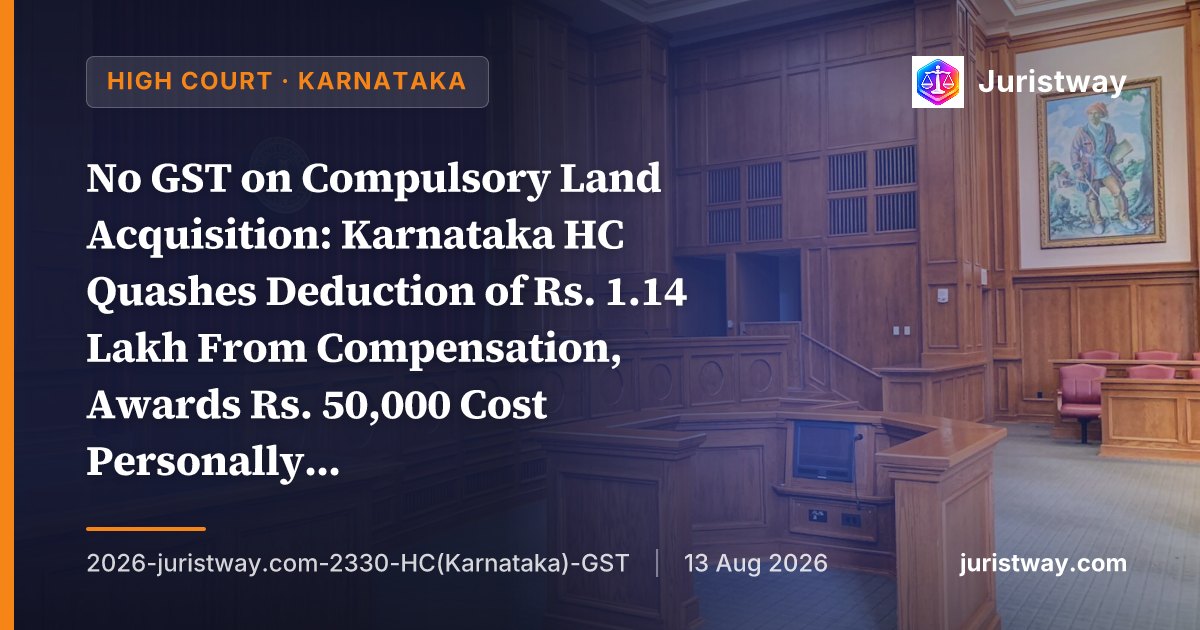
The Karnataka High Court has categorically held that GST cannot be levied on compensation paid to a landowner whose property has been compulsorily acquired by the State under its power of eminent domain. The ruling, by Justice R. Nataraj in Writ Petition No. 24040 of 2026 (Smt. Lalitha S v. Deputy Commissioner, Mandya, decided 13.08.2026), quashes the deduction of Rs. 1,14,815.29 (representing 18% GST) from the compensation awarded for acquisition of 10.08 guntas of land for NHAI road widening, and awards Rs. 50,000 in costs personally against the responsible official — recoverable from the Deputy Commissioner himself, not from government funds.
The facts are representative of a pattern that has been appearing across highway acquisition cases in Karnataka. The Special Land Acquisition Officer calculated compensation of Rs. 8,89,035.20 for the petitioner's land and structure in B. Agrahara Village, Mandya District. On the face of the award notice, a deduction of Rs. 1,14,815.29 was made for "GST @ 18%" — purportedly on the structural component of the compensation. The petitioner challenged this deduction, contending that the acquisition of immovable property by the State in exercise of its power of eminent domain does not constitute a supply of goods or services under the CGST Act and cannot attract GST.
The Revenue's response — that GST applies to the works contract/structure valuation component of the compensation — was found to be without any statutory basis. The court's reasoning is fundamental: the GST charging provision under Article 366(12A) of the Constitution levies tax on supply of goods or services. An immovable property (which includes any structure attached to land under Section 3 of the Transfer of Property Act) is not "goods" within the GST framework. And an expropriation of a citizen's property in exercise of statutory power of eminent domain does not constitute either a supply of goods or a provision of services. There is no transaction between the landowner and the State that can be characterised as a taxable supply — the owner neither sells voluntarily nor provides a service; the state takes what it requires by compulsion. The charging event that the GST law targets is simply absent.
The court also cited the Madras High Court's ruling in W.P. No. 3278/2024, where NHAI itself had conceded in its counter affidavit that no GST was applicable or charged on compensation paid to landlosers. The Karnataka court found this admission directly on point.
The cost direction is the most pointed signal. The court held that the respondent official had acted in excess of power in deducting GST, and that the petitioner had been compelled to approach the High Court over a "unwanted petition" caused by this unlawful deduction. Rs. 50,000 in costs was accordingly directed to be paid personally by the Deputy Commissioner — not from government funds — within one month. Interest at 15% per annum on the deducted amount was also directed to run from the date of the award to the date of payment.