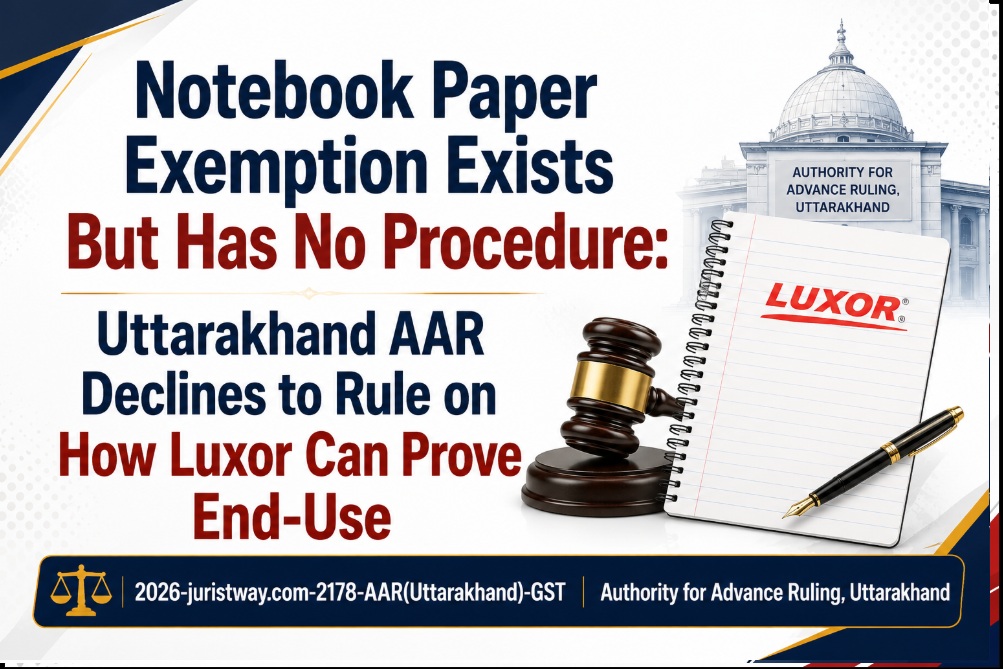
The Uttarakhand Authority for Advance Ruling has delivered a ruling that exposes a genuine structural gap in the GST rate notification regime: an exemption exists for uncoated paper used for manufacturing notebooks and exercise books, but the notification provides no procedure for a supplier to prove that its paper will actually be used for that purpose. The ruling in M/s Luxor International Private Limited (Ruling No. 4/2026-27, 10.08.2026) acknowledges the exemption's existence, interprets it correctly, but declines to pronounce on the mechanism for claiming it — holding that creating such a mechanism is a legislative and executive function, not an adjudicatory one.
The background is the 56th GST Council's recommendation to reduce GST on uncoated paper used for exercise books, graph books, laboratory notebooks and notebooks from 12% to Nil. Notifications No. 09/2025 and No. 10/2025 (both dated 17.09.2025, effective 22.09.2025) gave effect to this recommendation through a use-based bifurcation within Heading 4802: the 18% rate under Schedule II of Notification 09/2025 expressly carves out paper used for notebooks and exercise books, and Entry 128 of the Notification 10/2025 exemption schedule then covers this carved-out paper with a NIL rate.
Luxor International — itself a manufacturer of notebooks and exercise books, now proposing to also supply uncoated paper (HSN 48025590) to other notebook manufacturers — sought an advance ruling that this supply would be exempt under Entry 128. The statutory case was strong: both notifications read together create an unambiguous use-based distinction. The GST Council's press release confirmed the intent. Luxor proposed to obtain end-use declarations from buyers and post-manufacturing certificates confirming actual consumption.
The AAR confirmed the classification position without difficulty: the paper is under Heading 4802 and the two notifications create a clear use-based bifurcation. But it declined to pronounce on whether buyer declarations and purchase orders would suffice to establish compliance. The critical observation is that Entry 128 uses the expression "used for" — not "intended for use" or "supplied for the purpose of manufacture." This is a factual criterion, not one satisfied at the time of supply by reference to the buyer's stated intentions. And neither the CGST Act, the Rules, nor the notifications prescribe any mechanism for end-use verification — no bond execution, no certificate requirement, no post-supply audit trail, no recovery procedure for diversion.
The AAR held that prescribing such a mechanism — determining what form the declaration should take, who should give it, what happens if goods are diverted, what the supplier's liability is — would amount to supplementing the notification by creating administrative procedures absent from the law. This is beyond the Authority's jurisdiction under Section 98. The application was accordingly answered by confirming the existence and scope of the exemption, while declining to declare that specific documents would entitle the applicant to claim it. This is a legally correct but practically unsatisfying outcome. The ruling signals that the exemption's utility for upstream paper suppliers remains uncertain until the Government prescribes a mechanism for establishing end-use — either through a circular or a rule amendment — of the kind that exists for end-use exemptions in the Central Excise framework.