I. The Transitional Problem
The Finance Act, 2026 omitted clause (b) of Section 13(8) of the IGST Act, 2017 with effect from 30.03.2026. Until that date, intermediary services—commission agency, sourcing facilitation, marketing support and similar arrangements where an Indian service provider facilitates a transaction between a foreign principal and a third party—carried a statutory place-of-supply determination that located the supply in India, at the intermediary’s location. The practical consequence was that these services, regardless of the recipient’s location or the currency of payment, could not satisfy the cumulative conditions for “export of services” under Section 2(6) of the IGST Act.
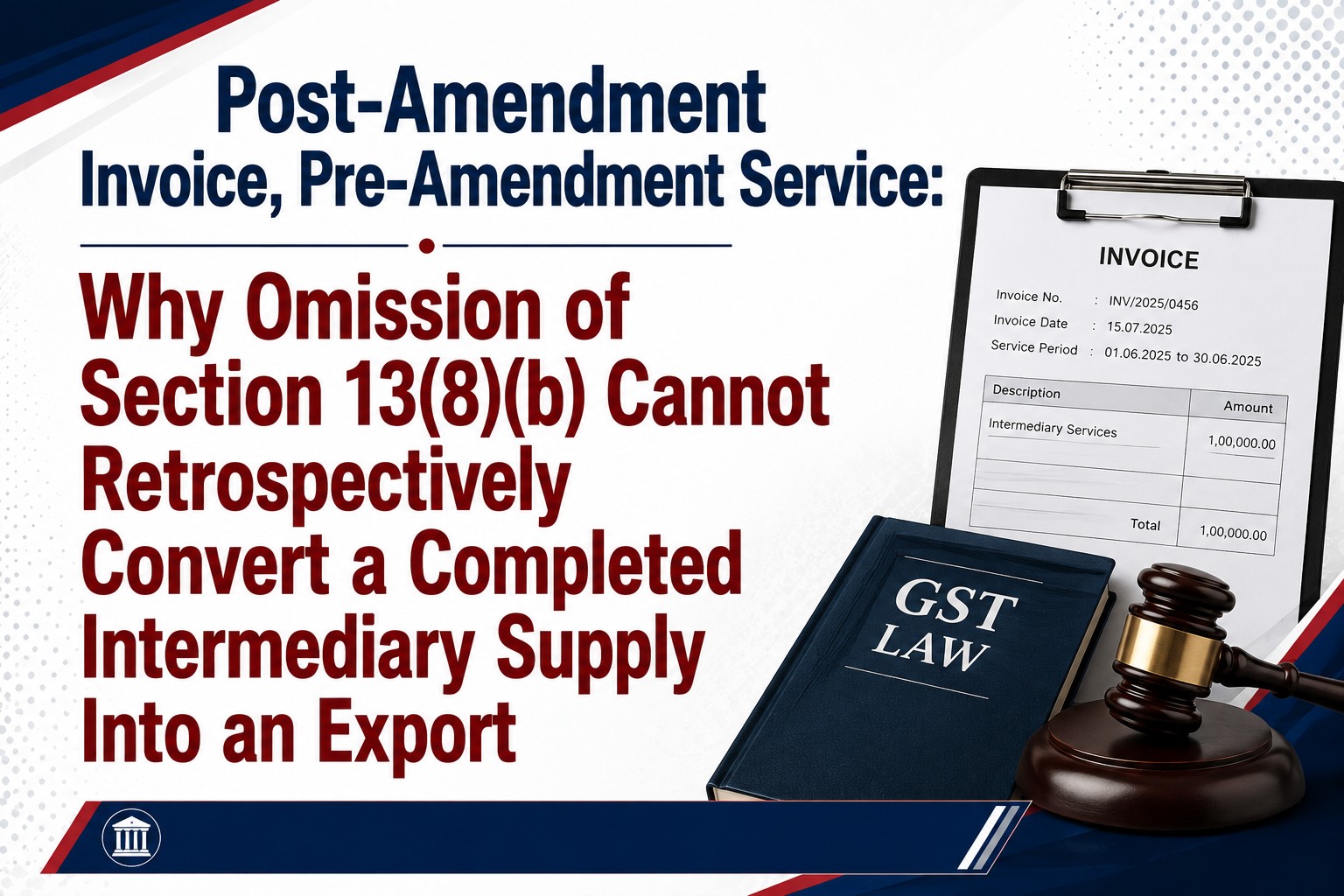
The omission removes this barrier for supplies made on or after 30.03.2026. A transitional difficulty arises, however, where the service was actually performed before the amendment but the invoice was raised and payment received after it. The question is straightforward: can a commission agent who completed the service in, say, February 2026, claim export status by issuing the invoice in April 2026 and receiving foreign exchange later that month? This note examines why, as a matter of statutory structure, the answer should ordinarily be no.
II. The Five Cumulative Conditions of Section 2(6)
Export of services is not a commercial label; it is a statutory definition. Section 2(6) of the IGST Act prescribes five conditions, all of which must be satisfied simultaneously: (i) the supplier must be located in India; (ii) the recipient must be located outside India; (iii) the place of supply must be outside India; (iv) payment must be received in convertible foreign exchange or in Indian rupees where permitted by the RBI; and (v) the supplier and recipient must not be merely establishments of the same person under Explanation 1 to Section 8 of the IGST Act.
In intermediary arrangements with a foreign principal, conditions (i), (ii), (iv) and (v) are often readily met. The dispute has historically centred on condition (iii)—place of supply. Before 30.03.2026, Section 13(8)(b) fixed the place of supply of intermediary services at the supplier’s location (i.e. India), and this single statutory provision defeated the entire export claim regardless of how convincingly the other four conditions were satisfied. The amendment removes this obstacle, but only for supplies whose place of supply falls to be determined under the amended law.
III. Time of Supply Determines Which Law Applies
The time-of-supply provisions in Section 13 of the CGST Act, 2017 determine when the tax liability on a service crystallises. This date is critical in a transitional scenario because the applicable place-of-supply law must be the law in force at the time of supply, not at the time of invoicing or payment.
Under Section 13(2), where the invoice is issued within the period prescribed by Section 31 (generally thirty days from the date of supply for services), the time of supply is the earlier of the invoice date and the payment date. Where the invoice is not issued within the prescribed period, the time of supply is the earlier of the date of provision of the service and the date of payment. If a commission service was completed in February 2026 and the invoice was raised only on 02.04.2026—well beyond the thirty-day window—the time of supply under Section 13(2)(b) reverts to the earlier of the service date (February 2026) and the payment date (28.04.2026). The earlier event is February 2026. The supply therefore crystallised before the amendment, and the place-of-supply determination must be made under the un-amended Section 13(8)(b)—which locates the supply in India.
The time-of-supply machinery is a tax-point provision. It fixes when liability arises. It does not convert a pre-amendment service into a post-amendment one merely because the invoice or payment happened to fall after 30.03.2026.
IV. Invoice and Forex Receipt: Evidence, Not Alchemy
Commercial instinct often treats a foreign-exchange credit as conclusive proof of export. Legally, however, it is only one of five conditions—and it cannot cure the failure of any other. An invoice raised on 02.04.2026 and a FIRC dated 28.04.2026 are relevant for return-filing, reconciliation and documentation, but they do not alter the character of a service already performed and taxable under the pre-amendment statutory framework.
A useful distinction is between documentation of supply and occurrence of supply. An invoice records a supply; it does not create it. A payment discharges the consideration; it does not determine when the service was provided. Where the underlying service was fully rendered in February 2026, a delayed invoice cannot shift the supply into the post-amendment period. Were it otherwise, any intermediary could convert a pre-amendment domestic supply into a post-amendment export merely by deferring the invoice—an outcome the time-of-supply provisions are specifically designed to prevent.
V. Prospective Omission and the Limits of Retrospective Benefit
Statutory amendments operate prospectively unless the legislature expressly provides otherwise or the nature of the provision clearly indicates retrospective intent. The Finance Act, 2026 omitted Section 13(8)(b) from a specified date without any transitional or saving provision extending the benefit to pre-amendment supplies. The omission therefore applies to supplies made on or after 30.03.2026.
There is, however, a narrow factual window that deserves attention. Commission arrangements are not always one-shot transactions. In some contracts, the right to commission crystallises only upon the occurrence of a post-supply event—acceptance of the purchase order, shipment of goods, realisation of sale proceeds, or achievement of a contractual milestone. If the agreement, correspondence and commission computation demonstrate that the service itself was continuing and the entitlement crystallised only after 30.03.2026, there may be a legitimate basis for applying the amended law to that portion. Such a claim must be supported by the contract, date-wise service records, commission calculations, email trail and accounting entries—not merely by a post-amendment invoice date.
VI. Refund Consequence: Zero-Rating Must Precede the Claim
A refund of IGST paid on export of services under Section 54 of the CGST Act presupposes that the supply qualifies as a zero-rated supply under Section 16(1)(a) of the IGST Act, which in turn requires the supply to satisfy Section 2(6). If the time of supply falls in February 2026 and the place of supply was India under the then-applicable Section 13(8)(b), the supply does not qualify as export and the IGST paid on it is not refundable as tax on exported services. The refund machinery cannot upgrade a domestic supply into an export; it can only process the consequence of a supply that independently satisfies the export definition.
VII. Practical Takeaway
For intermediary service providers navigating the transition, the operative question is not when the invoice was raised or when the foreign exchange was received, but when the service was provided and which place-of-supply law governed that supply. Where the service was completed before 30.03.2026, the omission of Section 13(8)(b) does not ordinarily convert that supply into an export. Where the commission entitlement genuinely crystallised after the amendment—supported by contractual and documentary evidence—the amended law may apply to that portion. The distinction is factual, and the burden of establishing it rests on the taxpayer.