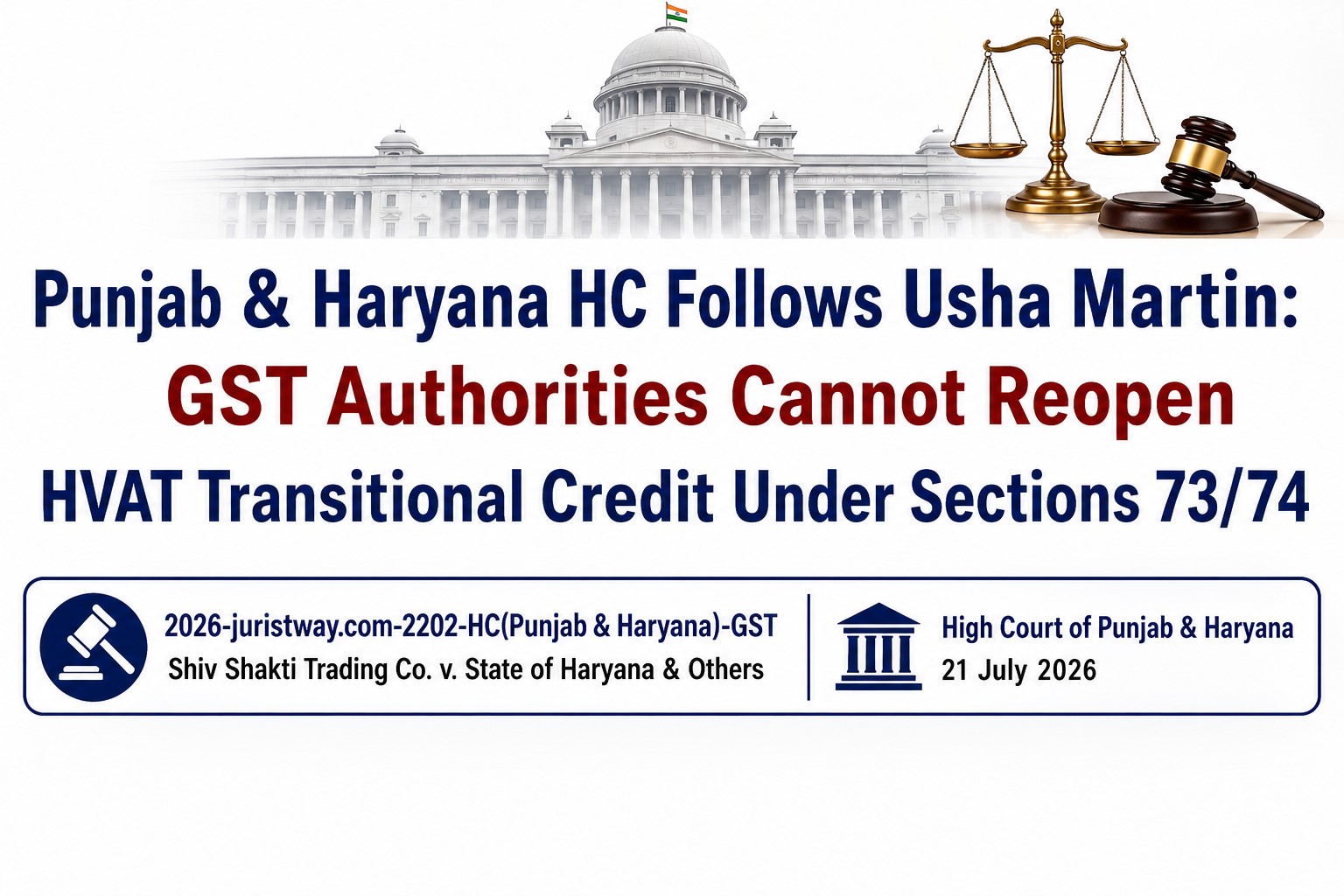
The Punjab & Haryana High Court has disposed of a batch of seven writ petitions filed by dealers and companies in Haryana on the settled authority of the Jharkhand High Court's ruling in Usha Martin Limited v. Additional Commissioner, CGST and Excise, affirming the position that GST adjudicating authorities have no jurisdiction to initiate or sustain proceedings under Sections 73 and 74 of the GST Acts to deny or demand recovery of Input Tax Credit availed under the erstwhile Haryana Value Added Tax regime and transitioned into the GST era. The decision, by a bench of Acting Chief Justice Ashwani Kumar Mishra and Justice Rohit Kapoor in CWP-2687-2021 and six connected matters (decided 22.07.2026), brings closure to a recurring category of litigation across Punjab and Haryana where GST officers had sought to reopen settled VAT-era credit positions.
The legal landscape on this point is now essentially consolidated. The Jharkhand High Court in Usha Martin Limited held that once CENVAT or State VAT credit was validly availed under the pre-GST legislation and transitioned into the Electronic Credit Ledger under the transitional provisions of the CGST Act, the jurisdiction to question that credit lies exclusively under the laws that governed its original availment, not under the GST adjudication machinery. This ruling was followed by a subsequent Jharkhand bench in Steel Authority of India Limited v. State of Jharkhand. More significantly, when the State of Jharkhand challenged the Steel Authority ruling before the Supreme Court, the SLP was dismissed on 17.04.2026 — making it clear that the top court was not inclined to disturb the underlying legal position.
The Punjab & Haryana High Court found itself in agreement with the Jharkhand view and allowed all seven writ petitions in the same terms. The initiation of proceedings under Sections 73 and 74 of the Punjab GST Act, Haryana GST Act and the CGST Act in respect of credits availed under the erstwhile Haryana VAT Act cannot be sustained in adjudication. The court preserved, in terms of paragraph 23 of the Usha Martin judgment, the Revenue's liberty to proceed in accordance with law under the appropriate legislation if such a remedy is available — but GST adjudication is not that route.
The ruling is directly relevant for any taxpayer in Punjab or Haryana who is currently facing or has received an SCN under Section 73 or 74 of the CGST/PGST/HGST Acts challenging ITC carried forward from the VAT era. Such proceedings are now clearly unsustainable on jurisdictional grounds, and the High Court has directed that they be dropped.