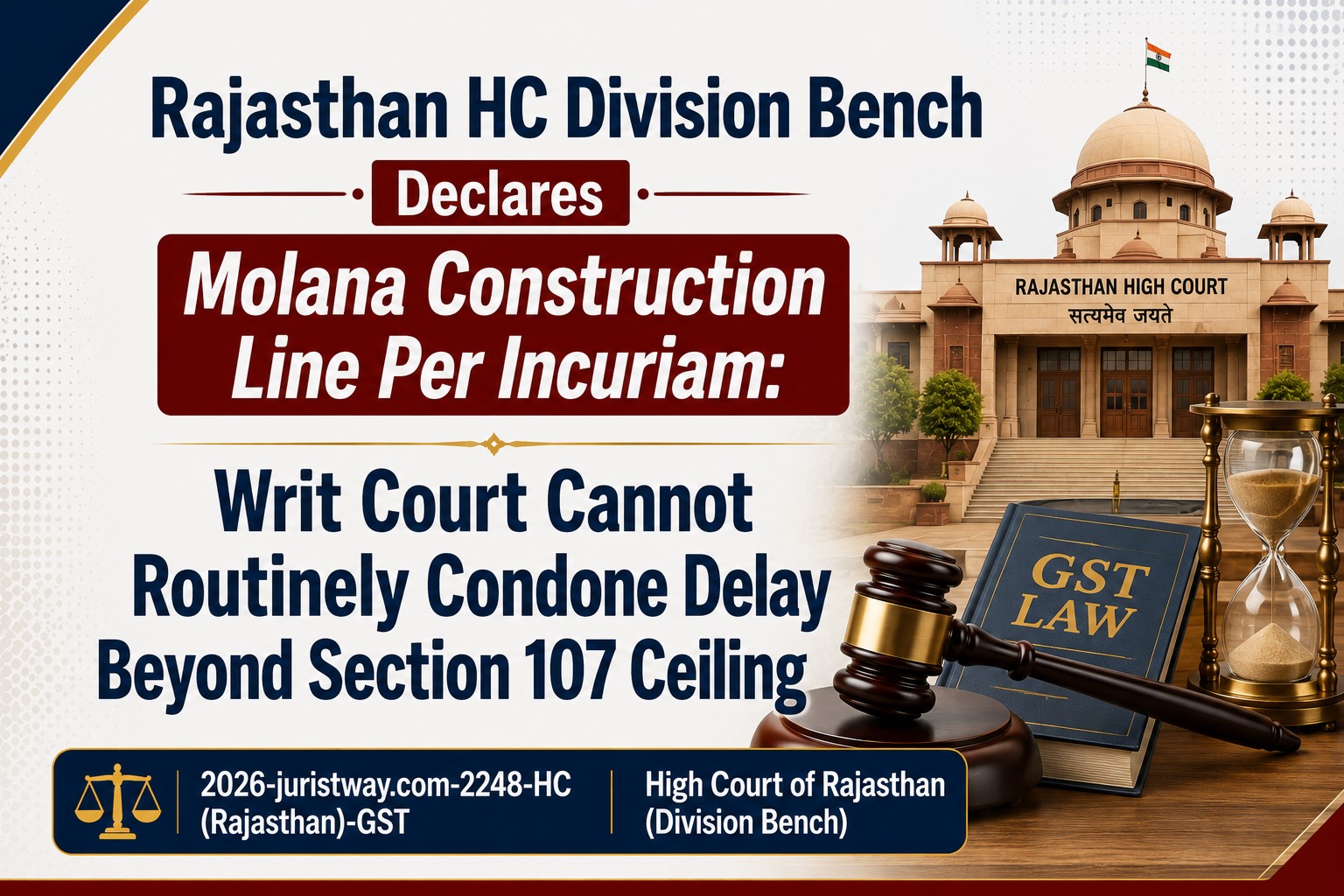
In a ruling that will significantly alter the landscape for GST registration cancellation cases in Rajasthan, a Division Bench of the Rajasthan High Court has formally declared the entire line of judgments beginning with Molana Construction Company (July 2024) — which had routinely condoned delays beyond the statutory ceiling under Section 107(4) of the CGST Act through exercise of Article 226 writ jurisdiction — to be per incuriam. The ruling in Shrawan Singh Devda v. Union of India (D.B. Civil Writ Petition No. 15910/2026, decided 18.08.2026) holds that these judgments were decided without taking into account binding precedents of both the Supreme Court and an earlier Division Bench of the same High Court, and are therefore not good law.
The factual background is typical of hundreds of similar cases. The petitioner's GST registration was cancelled under Section 29(2)(c) for failure to file returns for six consecutive months. The petitioner filed a statutory appeal under Section 107 but it was dismissed as time-barred — having been filed beyond both the original three-month limitation and the additional one-month condonable period provided under Section 107(4). The petitioner then filed a writ petition before the High Court seeking to have the cancellation set aside on merits. The Revenue resisted, arguing that the statutory limitation scheme is mandatory and exhaustive, and that writ courts cannot routinely bypass it.
The Division Bench identified three binding precedents that the Molana Construction line had failed to consider. The first was the Supreme Court's ruling in Glaxo Smith Kline Consumer Health Care Ltd. v. Assistant Commissioner (CT) LTU (2020), which had expressly held that High Courts cannot, as a matter of course, disregard the legislative mandate on limitation and entertain writ petitions to circumvent the statutory scheme — and that where a writ is filed after the expiry of the applicable statutory limitation, it cannot be entertained merely to enable adjudication on merits. The second was the Supreme Court's order in M/s Multi Trading Agencies Drangbal v. Union Territory of J&K (2025), which reaffirmed that delay beyond the statutory framework cannot be condoned. The third — and most direct — was the Rajasthan High Court's own earlier Division Bench ruling in Ashok Verandani v. Central Board of Indirect Taxes (March 2024), which had held that the Appellate Authority has no jurisdiction to condone delay beyond the period expressly permitted under Section 107(4), and that the writ court cannot circumvent this by direct remand to the Appellate Authority.
The court held that the Molana Construction judgment — and the series of judgments following it including Molana Construction, Man Singh Tanwar, RPC PSIPL JV and others — were decided without the benefit of these binding authorities and are therefore per incuriam in the technical legal sense: judgments that fail to notice relevant binding precedents and reach a result inconsistent with what those precedents require. They cannot be followed. The court was careful to add that this does not mean registration cancellation is irremediable — fresh registration remains available, as does challenge to the substantive validity of the original cancellation order in exceptional cases involving patent lack of jurisdiction or flagrant natural justice violation. But routine writ petitions seeking to condone Section 107 delay through Article 226 are no longer tenable before Rajasthan benches that follow this ruling.
The practical consequence is immediate and significant. In Rajasthan alone, the Molana Construction line had been cited as precedent in dozens of cases to justify delay condonation in registration cancellation writ petitions. All of those outcomes now depend on whether the bench hearing them follows Shrawan Singh Devda or Molana Construction. The resulting intra-court conflict between co-equal Division Benches — with Ritik Acharya (April 2026) and Kakar Automobiles (August 2026) decided by a different bench on the same day following the Molana Construction line — will need to be resolved by a Larger Bench.