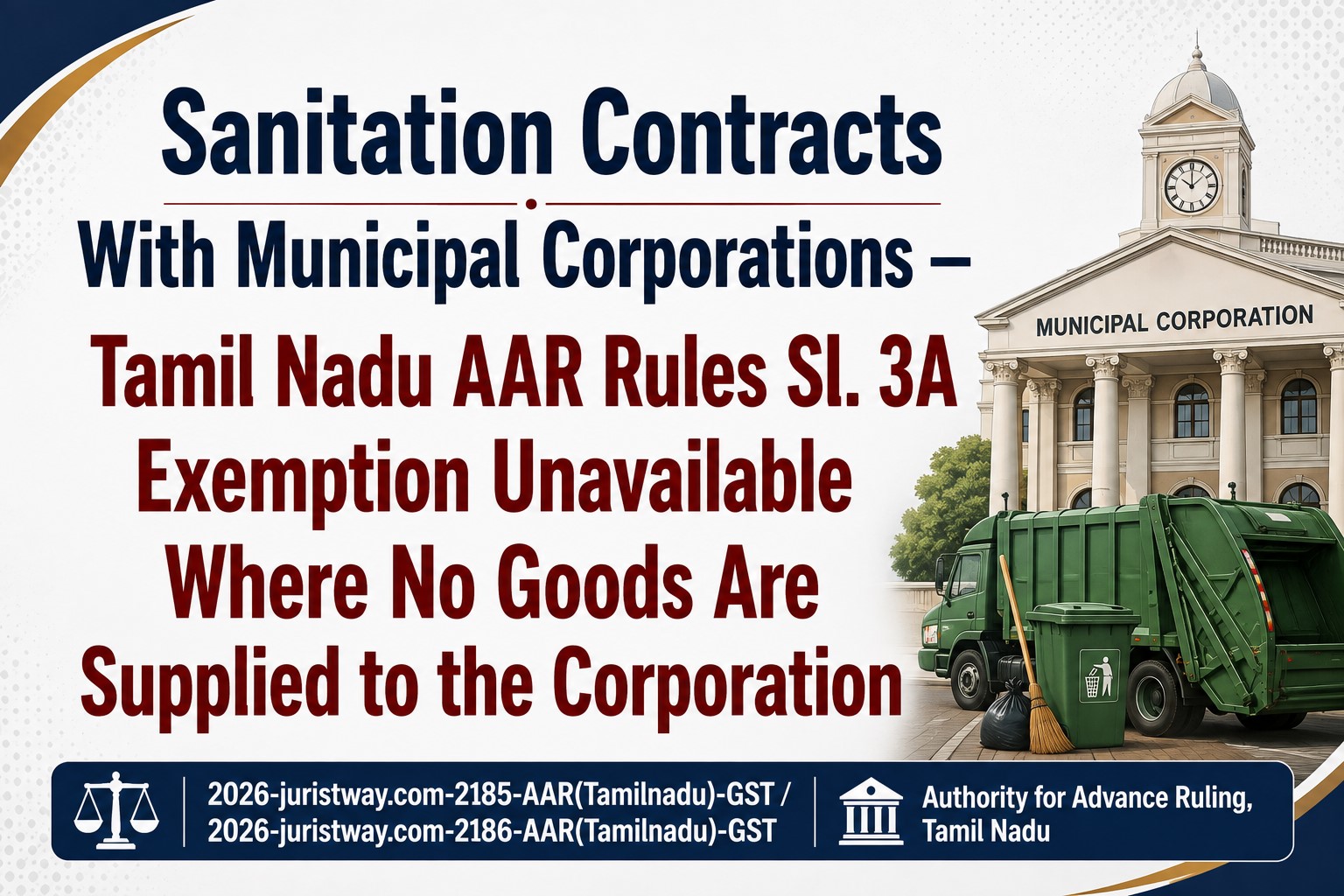
The Tamil Nadu Authority for Advance Ruling has issued two companion rulings on the same day covering two contracts of M/s Jay Kay Trans with the Greater Chennai Corporation — one for upkeeping and maintenance of TNUHDB housing units in Zone 15, Outer Perumbakkam, and another for upkeeping and maintenance of burial grounds in Zones 6 to 10 — and has held in both cases that the services are classifiable as general waste collection services but do not qualify for the Nil GST exemption under Serial No. 3A of Notification No. 12/2017-Central Tax (Rate). The rulings, TN/48/ARA/2026 and TN/49/ARA/2026 (both dated 27.07.2026), turn on a question of foundational importance for the sanitation sector: whether a contract that involves consumables, tools, bins and welfare kits for deployed personnel — all procured by the contractor at its own cost and without transfer of ownership to the municipal body — constitutes a "composite supply of goods and services."
The exemption under Serial No. 3A is available to a composite supply of goods and services (where the value of goods does not exceed 25% of the total supply value) provided to a local authority in relation to any function entrusted to a municipality under Article 243W of the Constitution. The applicant had argued that its contracts satisfied all three conditions: the supply was composite (manpower plus consumables and equipment), the recipient was the GCC (a local authority), and the function — sanitation and solid waste management — is a core municipal function under Entry 6 of the Twelfth Schedule. A Chartered Accountant's certificate showed goods constituted only 1.77% (housing) and 1.23% (burial grounds) of the contract value, well below the 25% threshold.
The AAR rejected the exemption on a point that the applicant's own contractual language made unavoidable. In its advance ruling application, Jay Kay Trans explicitly stated that the consumables, welfare kits and equipment used for the work are not transferred in ownership or possession to the GCC — "merely used for the purpose of work and the same is left as such once the contract period expires." The AAR took this admission at face value and concluded that it "automatically follows that the instant case does not involve any supply of goods to the GCC by the applicant." If there is no supply of goods to the GCC, the definition of composite supply under Section 2(30) — which requires two or more taxable supplies of goods or services, naturally bundled in the ordinary course of business — cannot be satisfied.
The ruling highlights a structural tension in the way sanitation and civic maintenance contracts are drafted and the GST exemption regime is designed. Municipal solid waste management is unquestionably a function entrusted to the GCC under Article 243W read with the Twelfth Schedule — and the AAR confirmed this. The classification rulings are also in the applicant's favour: waste collection services for residential housing units are classifiable under SAC 999423 (General waste collection services — residential) and waste collection services for burial grounds are classifiable under SAC 999424 (General waste collection services — other not elsewhere specified). But the exemption requires a composite supply of both goods and services, and where the contractual structure places all goods in the hands of the contractor as tools of the service — not as a separate supply to the client — that precondition is not met.
Contractors providing similar sanitation and upkeeping services to municipal bodies across the country will need to examine whether their contractual arrangements result in a supply of goods to the municipal body or merely the use of goods in rendering services. The distinction has significant GST liability implications. If services-only contracts dominate this sector, the Sl. 3A exemption will be consistently unavailable regardless of how small the goods component is.