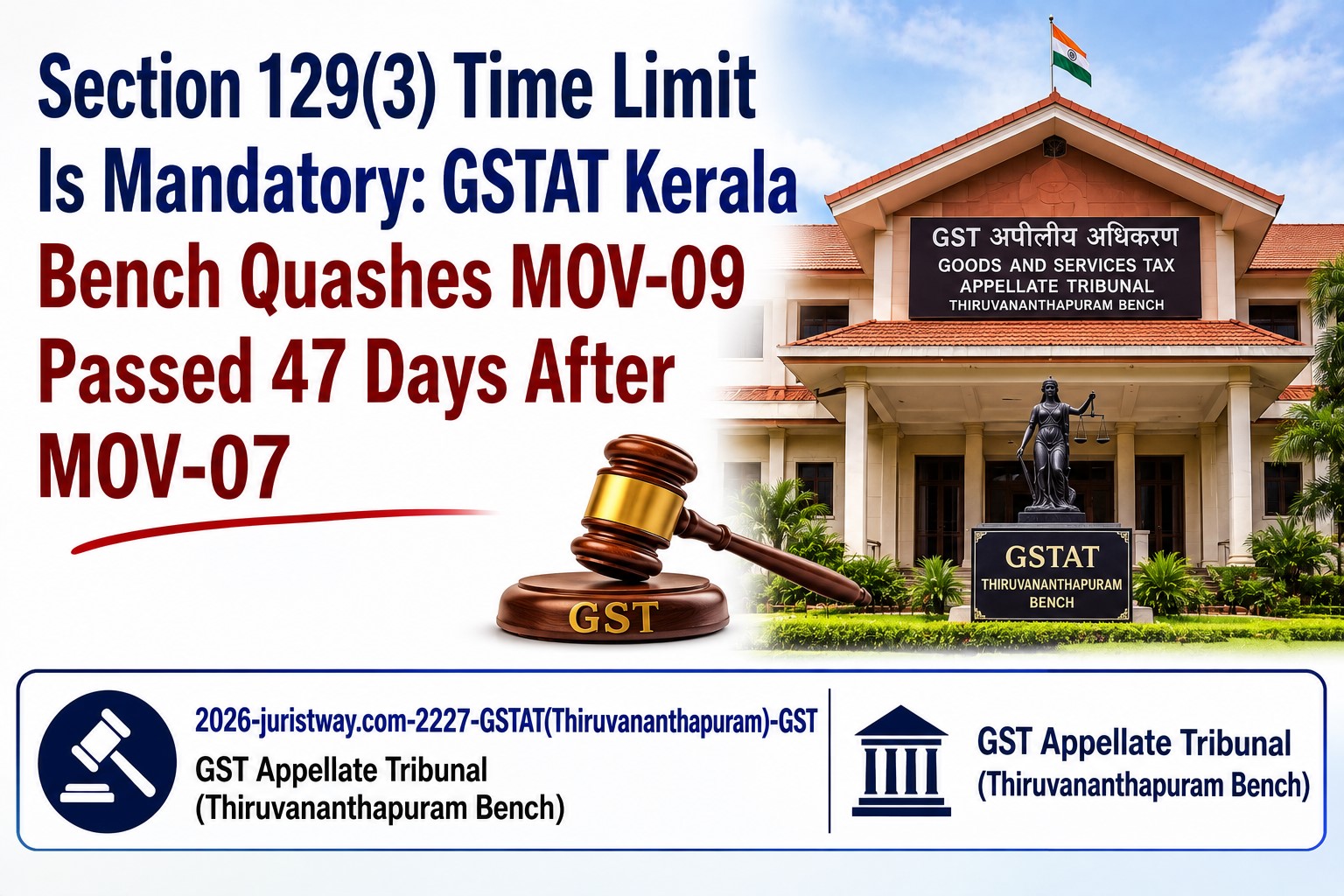
The first bench of the GST Appellate Tribunal constituted at Thiruvananthapuram has delivered an important ruling on the mandatory character of the seven-day deadline in Section 129(3) of the CGST Act for passing the penalty order (MOV-09) after issuing the detention notice (MOV-07). In its Final Order No. 02/TVP/KERALA/2026 in APL/2/TVP/2026 (Siddhi Vinayak Automobiles, decided 14.08.2026), the Tribunal held that the order under Section 129(3) must be passed within seven days of the service of the MOV-07 notice, and an order passed 47 days after the notice is without jurisdiction.
The case arose from a vehicle interception on 18.04.2022. The appellant — a registered automobile parts trader in Thiruvananthapuram — was transporting parts to a registered buyer under valid e-invoices (reflecting the supply on the GST portal in real time), but had not generated an e-way bill. The vehicle was detained under Section 129(1) and a MOV-07 notice was issued on 18.04.2022. The goods were released on 20.04.2022 against a bond and bank guarantee. However, the penalty order in MOV-09 was passed only on 04.06.2022 — 47 days after the MOV-07 notice, far beyond the seven-day deadline in Section 129(3). The first appellate authority upheld the penalty without examining the limitation issue.
Before the GSTAT, the Revenue raised a preliminary objection that the limitation ground was being raised for the first time at the second appellate stage. The Tribunal rejected this: the dates of the MOV-07 and MOV-09 were always on record, the first appellate authority had recorded them both in its own order, and the failure to examine a legal ground that was staring it in the face was the first appellate authority's error, not the appellant's omission. A legal issue clearly apparent from the record cannot be treated as a fresh ground being raised for the first time.
On the substantive question, the Tribunal followed a consistent line of High Court authority — J&K and Ladakh HC in Mohd Hazzak Lohar, Gujarat HC in Allcargo Logistics and Khatu Enterprises, Madras HC in Deepam Roadways, and Patna HC in Pawan Carrying Corporation — all of which hold that the word "shall" in Section 129(3) makes the seven-day deadline mandatory. The legislature's use of "shall" at two places in the provision (notice within seven days, order within seven days of notice) reflects an intent to prevent prolonged detention and harassment of traders through coercive statutory power. The Tribunal also noted that the appellant had generated valid e-invoices, filed GST returns and paid applicable GST on the relevant transactions — there was no mens rea to evade tax. The MOV-09 was quashed and the bank guarantee directed to be released immediately.