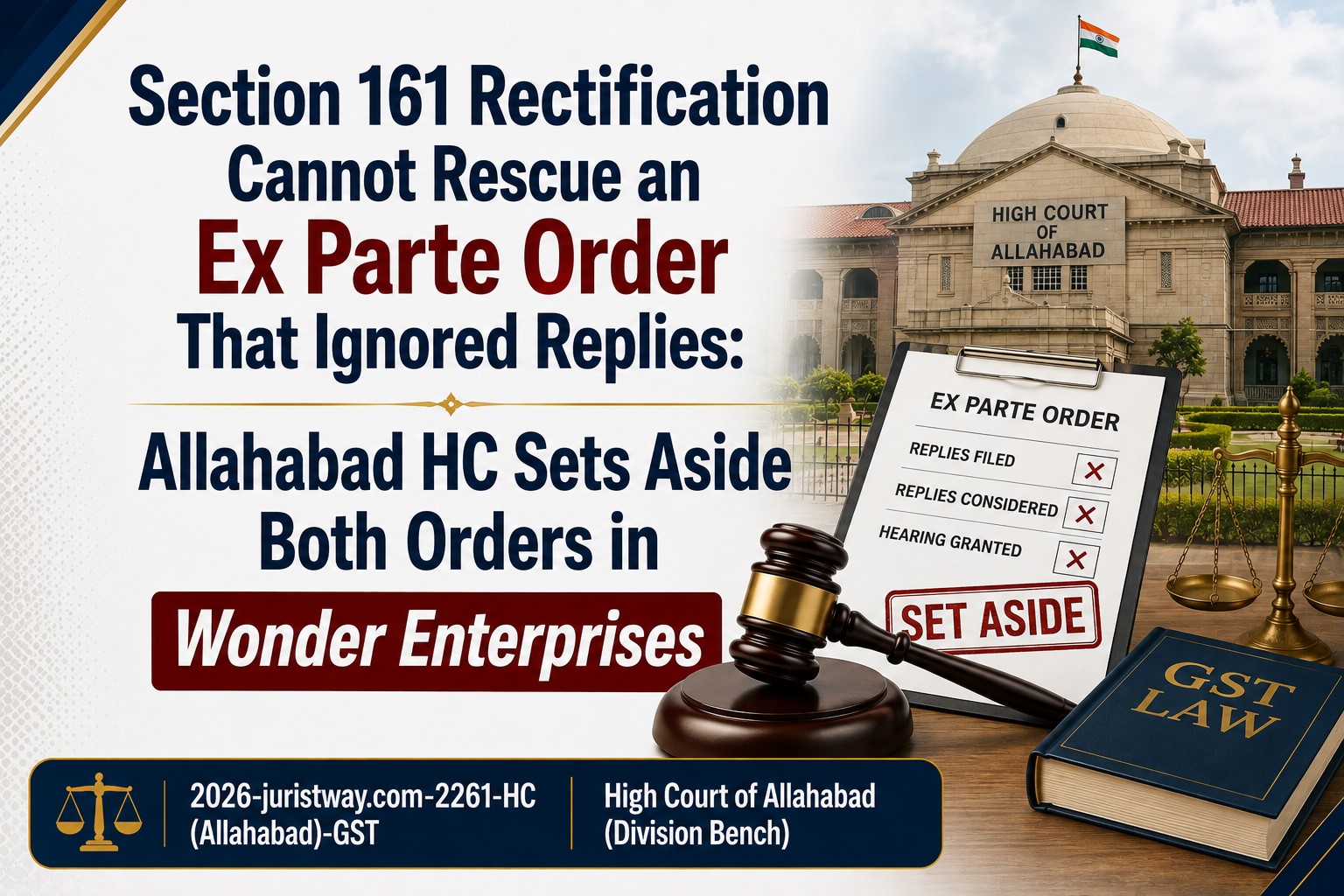
The Allahabad High Court has set aside two successive adjudication orders in a GST demand against M/s Wonder Enterprises, holding that where an authority passes an ex parte order without considering the assessee's duly filed replies and then purports to "rectify" this error under Section 161 by a second ex parte order — again without issuing notice or affording a fresh hearing — the Section 161 order is not a cure but a compounding of the original illegality. The ruling, by a Division Bench in Writ Tax No. 3203 of 2026 (decided 13.08.2026), draws a clear line between the permissible scope of rectification and what can only be addressed by recalling the erroneous order and adjudicating afresh.
The facts illustrate a failure that has become uncomfortably common in GST adjudication. A show cause notice under Section 74 of the CGST/UPGST Act was issued on 17.06.2021. The petitioner replied comprehensively on 13.07.2021 and supplemented that reply on 18.07.2021. Despite these replies being on record, the adjudicating authority passed a wholly ex parte order on 30.01.2025 — treating the matter as though no reply had been filed at all and confirming the full demand. The Revenue's own conduct then disclosed the error: within five days, on 05.02.2025, the same authority passed a second order purportedly under Section 161 (rectification of errors apparent on the face of record). This second order acknowledged that two replies had in fact been filed and proceeded to give them ex parte consideration, ultimately reducing — but still confirming — the demand. No notice was issued to the petitioner before the Section 161 order. No opportunity of hearing was afforded.
The court's analysis of Section 161's scope is the core of the ruling. The provision enables an authority to rectify "any error apparent on the face of record" in any decision or order passed by it, and this power is exercisable suo motu or on an application within three months. It covers obvious clerical or arithmetical mistakes and errors that are self-evident from the record without the need for argument or investigation. What it does not permit is a substantive review of the merits after the event — and this case fell far outside even a generous reading of Section 161. The error in the original order was not an error apparent on the record; it was a fundamental failure of adjudicatory process — the adjudicating authority either failed to look at the replies or chose to proceed as if they did not exist. That kind of error goes to the root of the order and can only be addressed by recalling it and starting the adjudication afresh, with the petitioner's replies considered and a fresh personal hearing afforded.
The purported Section 161 order was doubly defective: it was beyond the scope of the provision substantively, and it was passed without notice to the petitioner procedurally. Both orders were set aside. The matter was remanded to the adjudicating authority to pass a fresh order after issuing due notice to the petitioner, providing a fresh opportunity of hearing, and actually considering the replies filed in July 2021. The ruling is useful authority for practitioners challenging demand orders where the reply is demonstrably on record but the adjudicating authority has proceeded ex parte.