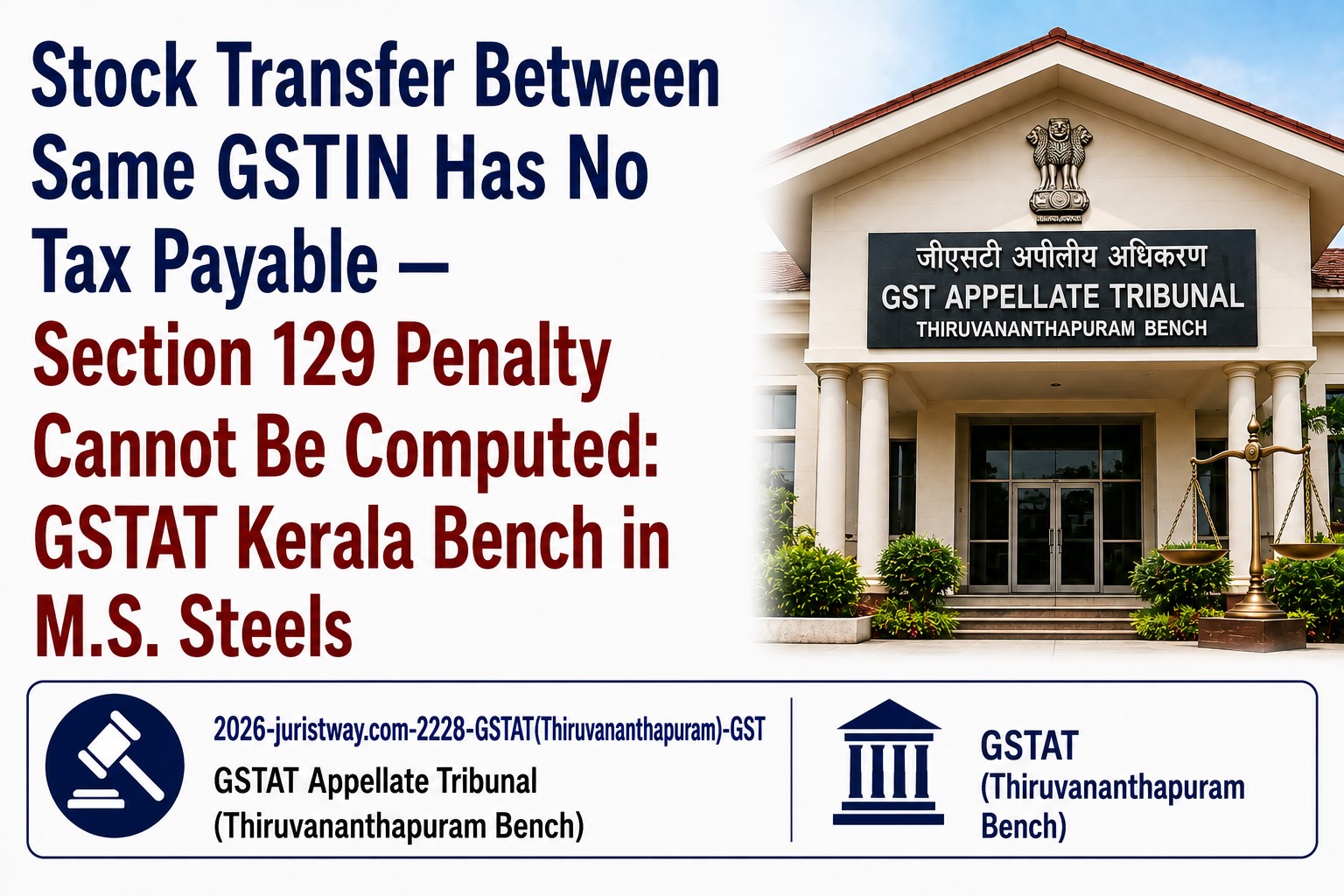
In its companion ruling pronounced on the same day, the Thiruvananthapuram Bench of the GSTAT has settled an important question on the intersection of Section 129 penalties and intra-firm stock transfers: where goods are being moved between two locations of the same registered person under the same GSTIN — a transaction that does not constitute a "supply" under Section 7 of the CGST Act and on which no tax is therefore payable — a penalty under Section 129(1) cannot be levied, because the penalty formula under that provision requires tax to be "payable" on the goods. Final Order No. 01/TVP/KERALA/2026 in APL/1/TVP/2026 (M.S. Steels, decided 14.08.2026) allowed the appeal, set aside the first appellate order and directed refund of the penalty paid.
M.S. Steels is a registered partnership firm dealing in steel goods, holding a single GSTIN covering both its head office and its godown. On 13.06.2022, it was transporting TMT bars from its principal place of business to its own godown under Delivery Challan No. M120 — a pure intra-firm stock movement, with no customer, no sale, no consideration. The vehicle was intercepted by a mobile squad, detained for absence of an e-way bill, and a penalty of Rs. 1,34,640 (equal to 100% of the "tax payable") was imposed and collected under Section 129(3). The first appellate authority confirmed the penalty, characterising the transaction as "not genuine" purely on account of the missing e-way bill.
The Tribunal's analysis begins with first principles. Section 9 of the CGST Act levies tax on intra-state supplies of goods. Supply is defined under Section 7 — and for a transaction to be a supply, it must involve at least two separate persons or entities and must be for a consideration. A stock movement from one location to another within the same GSTIN, belonging to the same legal person, involves only one entity and carries no consideration. It is therefore not a supply under Section 7, not an intra-state supply as defined in Section 8 of the IGST Act, and not within the charging provision of Section 9. With no tax payable, the formula in Section 129(1)(a) — penalty equal to two hundred percent of "the tax payable on such goods" — cannot be applied. The result is that penalty under Section 129 is simply incapable of being quantified and levied.
The Tribunal applied the Bombay High Court's ruling in Fabricship Pvt. Ltd. v. Union of India, which had authoritatively held that "tax payable" in Section 129(1)(a) contemplates a transaction that is actually liable for tax — not merely the hypothetical rate that would apply to goods of that description in a taxable supply. It also followed the Allahabad High Court in Vacmet India Ltd. and Goverdhan Oil Mill, both of which had held that stock transfers do not expose the taxpayer to Section 129 penalty for absence of an e-way bill. The Revenue's attempt to distinguish Fabricship on the ground that it involved exempted goods was rejected as a misreading of that judgment's ratio — the holding was about the nature of "tax payable" in the context of transactions outside the charging section, not about exempted goods specifically.
The Tribunal went further and addressed the question of what provision does govern such a breach: where a stock transfer is required to have an e-way bill under Rule 138(1)(ii) but does not have one, the applicable penal provision is Section 122(1)(xiv) (which penalises failure to maintain the prescribed documents) — not Section 129. Under Section 122(1)(xiv), the maximum penalty for such a breach is Rs. 10,000 CGST plus Rs. 10,000 SGST. This interpretation is important for the industry: it means that e-way bill failures in genuine stock transfers attract a relatively modest fixed penalty under Section 122(1)(xiv), not the potentially large percentage-of-tax penalty under Section 129.