Meeting Context and Revenue Under the Two-Rate Structure
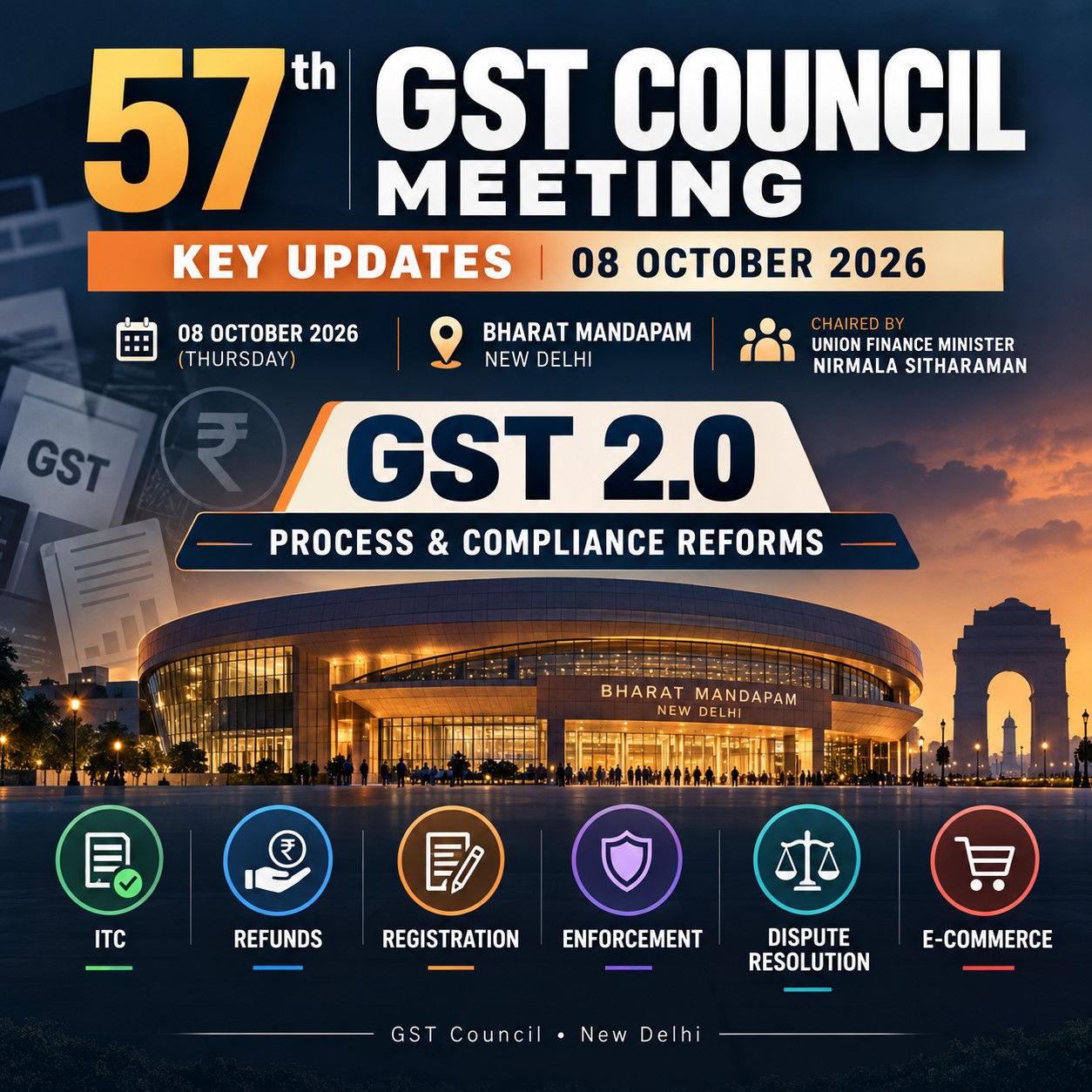
The 57th Meeting of the GST Council was held on October 8, 2026, in New Delhi under the chairpersonship of Union Finance Minister Smt. Nirmala Sitharaman. This was the first Council meeting since the 56th meeting held on September 3–4, 2025, which had approved the GST 2.0 overhaul and the two-rate structure (5% and 18%, with 40% on demerit goods).
The Council noted the following revenue and compliance trends after one year of the two-rate structure:
- Taxable supply rose from ₹40.19 lakh crore per month to ₹50.58 lakh crore — a 25.8% increase, against 13% growth in FY 2024-25.
- Supplies to consumers reported in the system rose from ₹5.98 lakh crore to ₹7.58 lakh crore per month — a 26.7% increase, 31% faster than overall taxable supply growth, indicating improved reporting.
- Gross tax liability increased from ₹5.85 lakh crore to ₹6.64 lakh crore per month — a 13.6% rise.
- The effective tax rate on domestic supply fell from 14.55% to 13.13%, a drop of about 1.5 percentage points.
- GST revenue grew 11% in FY 2026-27 over the previous year, and 14.7% during June–August 2026 over the corresponding months last year.
With rates now settled, the Council turned its attention entirely to process reforms — how GST works day to day for businesses.
Decriminalisation: Arrest Powers Removed, Prosecution Threshold Raised
The Council approved the removal of the power of arrest from GST law. This is the single most significant enforcement change since GST was introduced in 2017.
The threshold for prosecution has been raised from ₹1 crore to ₹5 crore. The minimum punishment stands removed, and the punishment — whether fine or imprisonment or both — is left entirely to judicial discretion in every case.
The general penalty, applicable where no specific penalty is provided, has been reduced from ₹25,000 to ₹10,000. A taxpayer who files late, makes a mistake, or falls behind on payment will face recovery, interest, and a proportionate penalty — and nothing beyond that.
The Council stated that decriminalisation is now possible because the GST system matches seller and buyer invoices invoice by invoice and can identify fake credit at the point of creation. Enforcement can now rest on detection rather than deterrence.
Input Tax Credit: Widened Scope and Stronger Protection
Credit on Ordinary Business Spending
The Council approved the following expansions to available input tax credit:
- Credit will now be available on health and life insurance taken for employees.
- Credit on telecommunication towers and pipelines laid outside a factory — both large capital items for those sectors — is now allowed.
- Credit will be available on free samples, and on stock written off on expiry of shelf life where a law requires the goods to be destroyed.
No Double Taxation on Resold Services
A service bought and sold again in the same line of business will carry tax once rather than twice. Hotel accommodation up to ₹7,500 per night booked through an agent, restaurant and catering services, and passenger transport are the common instances affected. Credit was denied on these because the applicable rate was 5% without credit. The chain will now run through.
Refund of Tax on Input Services and Plant & Machinery Under Inverted Duty Structure
Where a business has unused credit due to an inverted rate structure, refund was previously confined to goods. Tax paid on input services is now included and will be available for credit availed on or after November 1, 2026.
Tax paid on plant and machinery was excluded from refund altogether — for exporters as well as for businesses with an inverted rate structure. That exclusion has been removed. Refund on plant and machinery will be computed at one-sixtieth of the credit for each month, matching the working life of the asset, and will be available for credit availed on or after April 1, 2027.
The Council noted that sectors like pharmaceuticals and FMCG will see improved working capital management after this change.
Protecting the Genuine Buyer
A Committee of Officers will be constituted to examine the issue of protecting a genuine buyer who holds a proper invoice, has received the goods, and has paid the supplier in full. The Committee will complete its study within three months, and an agenda will be placed before the next Council meeting.
Note: The broader reform of Section 16(2) — concerning the conditions for claiming input tax credit by the genuine buyer — has been referred to the Committee of Officers described above. The amendments to Section 17(5), removing ITC restrictions on the items listed above, were approved.
Refunds: Faster, System-Driven Sanction
The Council approved a series of reforms to the refund process:
- The time limit for acknowledgement of a refund claim has been reduced from 15 days to 10. If neither an acknowledgement nor a deficiency memo is issued within 10 days, the claim will be treated as acknowledged.
- The system — not the officer — will sanction 90% of the claim on a risk assessment, and the order will issue within 3 working days of acknowledgement instead of the present 7.
- Refund of an excess balance in the electronic cash ledger will become fully automatic, with no officer involvement.
- The claim form will carry its own details, with shipping particulars drawn from customs and payment particulars from the banking system.
The Council noted that 65% of all refund claims are on exports or on an inverted rate structure, and 55% of those are already rated low-risk. A further 19% are balances in the cash ledger — money already with the Government.
Dispute Resolution: Common Standards, Lower Penalties, Pre-Deposit Cap
One Standard for All Notices and Orders
A comprehensive circular will be issued providing guidelines on how a notice is issued and served, how a pre-notice intimation is given, when fraud may be alleged, how a hearing is conducted, and how an order is written. The Council has directed that fraud, wilful misstatement, or suppression of facts should be invoked only based on the merits in each case.
₹10,000 Floor for Notices
Below a monetary threshold of ₹10,000 (CGST + SGST + IGST + Cess taken together), no show cause notice will be issued. Notices and appeals already pending below this threshold will be decided as if the threshold had been in force when the notice was issued.
Reduced Penalties
In non-fraud cases, a reduced penalty of 5% will apply where tax along with interest is paid within 30 days of the adjudication order under Section 73, or within 60 days under Section 74A. The condition of minimum penalty of ₹10,000 in non-fraud cases stands removed. Where the full tax amount is voluntarily paid along with interest and penalty within the specified time, the penalty will be deemed as a 'charge'.
₹40 Crore Cap on Pre-Deposit for Penalty-Only Orders
An upper limit of ₹40 crore (₹20 crore under CGST and ₹20 crore under SGST/UTGST) has been introduced on the pre-deposit payable for filing an appeal before the Appellate Authority or the Appellate Tribunal in cases where the order involves only a penalty and no demand of tax.
Opportunity of Hearing Before Blocking Credit (Rule 86A)
Rule 86A of the CGST Rules has been amended to provide a mechanism for a taxpayer to file an objection against blocking of any amount in the electronic credit ledger and to avail a personal hearing before the officer takes a decision.
Registration and Returns: Automated Approval and Mismatch Corrections
Registration
Registration is presently granted by the system within 3 working days, with no officer involvement, for low-risk applicants and for those whose output tax on supplies to registered persons does not exceed ₹2.5 lakh per month. The Council noted that 61% of registrations already come through this automated route; the remaining 39% go to an officer.
Going forward, the application form will guide the applicant, showing only the fields that apply and mapping each document to its purpose. Between November 2025 and September 2026, 16.73 lakh applications were filed to amend registrations — of these, 10.95 lakh (65.45%) were changes of trade name, director/partner, or additional place of business address. These amendments will now be accepted automatically.
Returns: Correcting Mismatches
The Council noted that approximately 95,000 system-generated notices are issued annually on return mismatches, with recovery against them at about 0.08% of the amount involved — almost entirely data entry errors.
The following corrections have been approved:
- A seller who reduces something already reported will do so in his sales statement, so the change reaches the buyer who claimed credit on it.
- Corrections will be allowed for earlier periods.
- A buyer registration number keyed in wrongly can be corrected.
- Credit will be settled through the Invoice Management System (IMS). What the buyer accepts is what enters his return.
Ease of Doing Business
Automated Cancellation of Registration
Closure of registration will be automated in stages, beginning with smaller taxpayers. Around 90% of taxpayers seeking cancellation have never passed on credit above ₹2.5 lakh in any month. The final return will form part of the closure application instead of being a separate step afterwards. Where the system has suspended or cancelled a registration for a missing return or missing bank details, it will restore the registration once the taxpayer makes it good.
Annual Filing for Small Taxpayers
An optional scheme has been approved in principle under which a taxpayer with turnover up to ₹5 crore who supplies only to consumers files a return once a year and pays tax quarterly. On average, 16.85 lakh taxpayers out of 1.05 crore active taxpayers report only such supplies; of these, 16.66 lakh (99%) are below ₹5 crore and together account for less than 1% of total tax liability. The detailed framework and necessary amendments will come to the Council at its next meeting.
Goods in Transit: Intelligence-Based Checks Only
A vehicle may be stopped only on specific intelligence, and the decision to stop must be authorised in advance by an officer not below the rank of Joint Commissioner. Only the source state and the destination state may inspect goods in a conveyance — states along the route will no longer be able to stop the vehicle. A consignment crossing five states was previously open to being checked in each; it will now be checked at origin and destination only. The e-way bill document is still required and matched in the system — what changes is that physical checks follow information rather than precede it.
The provision for confiscation of goods and conveyances under Section 130 of the CGST Act will not apply to goods and conveyances in transit.
Late Fee Relief for Small Taxpayers
Late fee on delayed filing of the monthly return under Section 39(1) will be waived for taxpayers with annual turnover up to ₹5 crore in the preceding financial year, provided the delayed return is filed by the end of the month in which it was due.
Transfer of Title in IPR Treated as Supply of Services
Schedule II of the CGST Act will be amended so that transfer of title in Intellectual Property Rights — whether temporary or permanent — is uniformly treated as supply of services. This will ease compliances and facilitate cross-border IPR transactions.
E-Invoicing Extended to RCM and Import of Services
E-invoicing will be extended to domestic supplies received from unregistered persons under reverse charge mechanism, and to the import of services, for taxpayers with aggregate annual turnover of ₹5 crore and above.
Validation Clause for Multi-Year Notices
A validation clause will be introduced in the CGST Act for notices that have been held invalid by various courts on the ground of having been issued for multiple financial years.
Returns: Alternate Mechanism for Liability and ITC Correction
The Council has approved an alternate mechanism for amendment of liabilities and ITC in returns, to come into force from the return of April 2027. This includes enhancements in GSTR-1/1A/IFF for better reconciliation with GSTR-3B, a new Electronic Statement for RCM credit, an Electronic Credit Reversal and Reclaim Statement, and credit note handling through IMS. The proposed mechanism will be placed in the public domain for time-bound consultation before implementation.
GST Appellate Tribunal (GSTAT)
Amendments to the CGST Act and the GSTAT appointment rules have been approved to align the Tribunal's provisions with the Tribunals Reforms Act, 2026, and the National Tribunals Commission Rules, 2026.
Export of Services: Wider Export Status
Billing Through a Foreign Branch
An Indian firm that serves a foreign client through its own branch abroad will now get export benefit. The condition in the law that stood in the way is being removed, even though foreign exchange is received in the normal course. Analytics firms, design studios, engineering consultancies, and the offices global companies operate from India all fall within this.
Work Done in India on a Foreign Client's Goods
Work done in India on goods belonging to a foreign client — such as testing, repair, certification, research, or processing — will count as an export of service even though the goods do not leave the country. For contract manufacturing and processing, India is placed on the same tax footing as competing locations.
Receipt of Payment and Refunds for Exporters
When an export payment counts as received will follow the Reserve Bank rules, so one standard applies instead of two. Taken together with the refund changes, an exporter of services will recover the tax on what he spends — and recover it quickly — since costs for such exporters sit largely in services and equipment.
Delivery in SEZ/FTWZ for Overseas Buyer
Where goods are supplied to an overseas buyer but delivery is made in an SEZ or FTWZ, and payment is received in convertible foreign exchange or in Indian Rupees where permitted by RBI, the supply will be deemed to be a supply to the SEZ/FTWZ and will qualify for zero-rating benefit.
Electronic Commerce: Access for Small Sellers and Uniform Tax
Inter-State Reach for the Smallest Seller
Under the present law, a seller needs a place of business in every state he sells into. A small seller cannot set one up, so he stays within his home state while larger sellers sell across the country.
The Council has approved that a small seller may now declare the warehouse of an electronic commerce operator in another state as his principal place of business there, with the operator's consent (to be given automatically by the system). The seller must maintain a physical presence in at least one state (his home state), and the registration is limited to supplies made through platforms — one registration per PAN per state.
More than 90% of sellers supplying through platforms pass on credit below ₹2.5 lakh per month. A seller who crosses that threshold moves to ordinary registration.
One Tax Rule for Every Platform
Platforms built on different commercial models have been reading the same provision differently, resulting in the same delivery to the same customer carrying tax differently depending on how the platform arranges its contracts. The Council has approved that tax on a booking will turn on the service actually delivered — the same delivery will bear the same tax, whichever way it is routed.
Rate Clarifications and Changes on Goods
No headline rates were changed at this meeting. Rate matters will be taken up once a year at a meeting set aside exclusively for that purpose. What was addressed were clarifications, corrections, and anomalies remaining after last year's rate rationalisation. Key decisions on goods:
- Sublimation paper classified under heading 4809; past cases regularised on "as is where is" basis.
- Toys under heading 9503 — all categories (dolls, puzzles, etc.) covered, not just tricycles and scooters.
- Seaweed extract based bio-stimulants registered under Schedule VI of the Fertiliser Control Order classified as fertilisers under heading 3101; past cases regularised.
- Second-hand vehicle margin scheme — ITC allowed on inputs (spares, repair, technology, rent, marketing) other than the procured second-hand vehicle itself.
- Waste and scrap of plastics, electrical/electronics waste, tyre waste, and used cooking oil brought under Reverse Charge Mechanism (RCM) when supplied by unregistered to registered persons. TDS at 2% introduced on B2B supplies of such specified waste and scrap by registered persons.
- Psyllium seeds (Isabgol) — NIL GST, irrespective of whether fresh, chilled, frozen, or dried.
- Re-treaded tractor tyres — GST rate aligned with new tractor tyres.
- Compensation Cess exemption for CSD on two-wheelers and four-wheelers (01.07.2017 to 30.09.2022), and on aerated drinks by CSD and Unit Run Canteens (01.07.2017 to 31.03.2022).
Rate Clarifications and Changes on Services
- Passenger transport and motor vehicle rental using electric vehicles — option to pay GST at 5% with restricted ITC, where battery charging cost is included.
- Delivery services (other than courier/postal) supplied through e-commerce operators by unregistered suppliers brought under Section 9(5); GST at 5% without ITC.
- Delivery services for goods supplied/ordered through e-commerce — 5% without ITC; GST exemption on GTA transport to unregistered persons excluded where services relate to goods supplied through ECO.
- Motor vehicle leasing — clarification on GST treatment of statutory and ancillary recoveries (registration charges, road tax, insurance, FASTag) recovered by lessor from lessee.
- Limited ITC in the same line of business for restaurant/outdoor catering services, hotel accommodation up to ₹7,500 per night, and gym/fitness services — on the same basis as presently available for passenger transport, tour operators, and motor vehicle rental.
- Helicopter passenger transport on seat-sharing basis from/to airports and helipads in north-eastern states, Sikkim, and Bagdogra — exempt from GST.
- Storage and warehousing of seeds meant for sowing — exempt.
- Agricultural support services of curing coffee by coffee curers to cultivators — exempt.
- Services by Seamen's Provident Fund Organisation (SPFO) — exempt.
- R&D services — simple self-certification mechanism by the head of institution, certifying the activity is research and not consultancy, for exemption eligibility.
- Import of services by Indian establishments of foreign shipping lines from related persons outside India, without consideration — exempt; past period regularised.
- Upfront/concession amount paid to NHAI under Toll Operate Transfer (TOT) model for highway projects — exempt.
- Operation and Maintenance services by concessionaires for highway projects under TOT model — special procedure for valuation and time of GST payment.
- Fund Transfer Pricing in banks — the notional "interest" in FTP transactions between branches qualifies as "interest" under the exemption notification.
Deferred and Pending
The broader reform of Section 16(2) — the conditions under which a genuine buyer may claim input tax credit when the supplier has defaulted — has been referred to a Committee of Officers for study within three months. An agenda will be placed before the next Council meeting.
Three National Coordination Meetings of Central and State officers were held over the past year, in addition to several smaller officer-level meetings. Every proposal went to the states before it came to the Council.
What Comes Next
None of these recommendations become law on the date of the meeting. CBIC will issue the corresponding notifications, circulars, and instructions to implement the approved changes. The key effective dates announced so far are:
- November 1, 2026 — ITC on input services becomes available under inverted duty structure refund.
- April 1, 2027 — ITC on capital goods becomes available for refund (at one-sixtieth per month); alternate mechanism for liability and ITC correction in returns comes into force.
The Committee of Officers on genuine buyer protection under Section 16(2) will report within three months. The detailed framework for the Annual Return Quarterly Payment (ARQP) scheme for taxpayers up to ₹5 crore will come before the next Council meeting. The proposed return amendment mechanism will be placed in the public domain for time-bound stakeholder consultation.
FAQs are being issued for clarification of doubts arising from the recommendations.
Sources
- PIB Press Release — Recommendations of the 57th Meeting of the GST Council (PRID 2320934)
- Note on Outcomes of 57th Meeting of the GST Council (PDF)