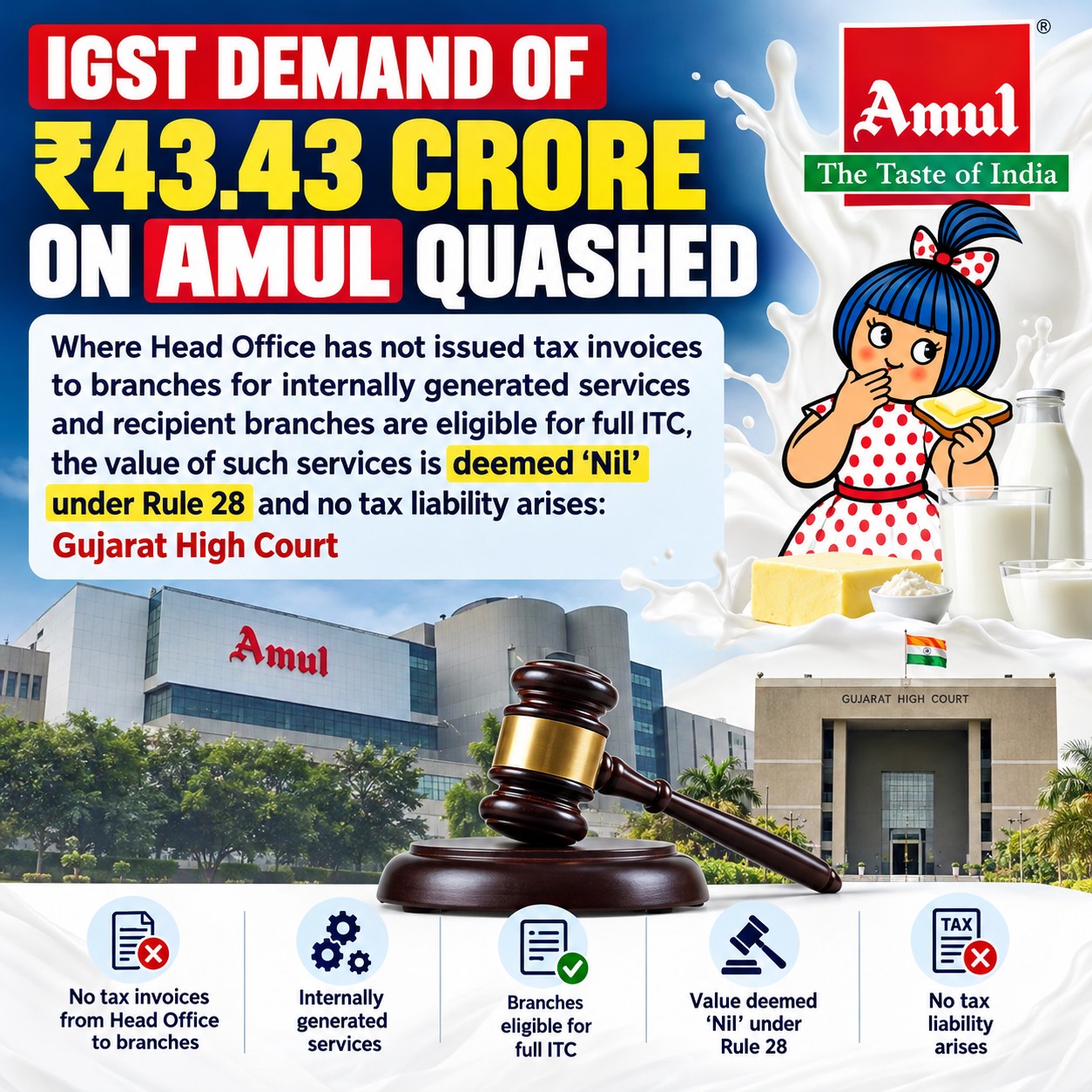
The Division Bench held that the CBIC Circulars dated 17 July 2023 and 26 June 2024 are self-explanatory — where no tax invoice has been issued by the Head Office to its branches in respect of common corporate services, the value of such services is deemed to be declared as 'Nil' and the open market value under Rule 28 of the CGST Rules is deemed to be 'Nil'; further, the mere failure to adopt the cross-charging mechanism cannot ipso facto lead to the conclusion that the Federation wilfully or fraudulently evaded payment of tax, especially when the entire situation would have been revenue-neutral.
The Gujarat High Court has quashed an Order-in-Original confirming a demand of IGST aggregating to ₹43,43,12,441 against the Gujarat Co-operative Milk Marketing Federation Limited — popularly known as "Amul" — under Section 74 of the CGST Act, holding that the demand was unsustainable on two independent grounds: the value of the internally generated services was required to be treated as 'Nil' in the absence of tax invoices, and the invocation of Section 74 was without jurisdiction for want of foundational facts establishing fraud, wilful misstatement or suppression [M/s Gujarat Co-operative Milk Marketing Federation Limited v. Union of India and Others, 2026-juristway.com-2928-HC(Gujarat)-GST].
The Federation, an apex farmers' co-operative society with its Head Office at Anand, operates branches and depots across India and holds a GST registration as an Input Service Distributor for its Head Office. It also holds a common GST registration for all branches and depots within Gujarat and separate registrations for branches outside Gujarat. For the period July 2017 to March 2019, the Federation incurred various corporate expenses at its Head Office — including advertisement, publicity, IT infrastructure, SAP maintenance, legal fees and employee salaries — which were utilised by both the Head Office and the branches. The Federation did not allocate these expenses to its branches by adopting the cross-charging mechanism during the disputed period, though it began doing so from April 2019 onwards.
The DGGI initiated an investigation and the respondent authorities issued a show cause notice under Section 74, alleging that the Federation had deliberately and fraudulently failed to cross-charge the common expenditure to its branches, which were treated as distinct persons under Section 25(4) of the CGST Act. The Order-in-Original dated 1 January 2025 confirmed the demand of ₹43.43 crore along with interest and penalty, holding that the supply of services by the Head Office to its distinct units was liable to tax at the value determined under the applicable valuation rules. The adjudicating authority had cursorily referred to CBIC Circulars dated 17 July 2023 and 26 June 2024 but brushed them aside, recording that the Federation had not established that 100% ITC on any particular invoice was to be passed on to a single branch or depot.
Justice A.S. Supehia and Justice Vaibhavi D. Nanavati first addressed the statutory framework. The Court noted that while Section 25(4) and (5) of the CGST Act treats branches with separate GST registrations as "distinct persons," and Entry 2 of Schedule I subjects supply between distinct persons to GST even without consideration, the valuation of such supply is governed by Rule 28 of the CGST Rules. The second proviso to Rule 28 provides that where the recipient is eligible for full input tax credit, the value declared in the invoice shall be deemed to be the open market value. CBIC Circular No. 199/11/2023-GST dated 17 July 2023 clarified that where the recipient branch is eligible for full ITC, the value declared by the Head Office in the invoice is deemed to be the open market value, irrespective of whether the cost of any particular component such as employee cost has been included. Critically, the Circular further clarified that where the Head Office has not issued a tax invoice to the branch office in respect of any particular service, the value of such service "may be deemed to be declared as 'Nil' by HO to BO, and may be deemed as open market value in terms of second proviso to Rule 28 of CGST Rules." This position was reiterated in the subsequent Circular No. 210/4/2024-GST dated 26 June 2024.
The Court held that since it was not disputed by the respondents that the Federation's Head Office had not issued any tax invoices to its branches and depots in respect of the services in question, the value of such services was required to be treated as 'Nil' in terms of Rule 28 of the CGST Rules, and consequently no tax liability arose. The Court followed the Delhi High Court's decision in Metal One Corporation India Pvt. Ltd. v. Union of India [2024-juristway.com-1168-HC(Delhi)-GST], where identical Circulars had been considered and the show cause notices had been quashed on the ground that where no invoices were generated, the value of the service must be treated as 'Nil', rendering any proceedings "futile and impractical." The Court held that the impugned order suffered from non-application of mind on the effect of the taxable value being 'Nil' since no invoice had been issued by the Federation, and that the adjudicating authority could not determine the value on a proportionate basis merely because the Federation did not adopt the cross-charging mechanism.
On the second and independent ground, the Court struck down the invocation of Section 74. Relying on the Supreme Court's recent decision in Tata Steel Ltd. v. Union of India [2026 ], the Court held that when Section 74 provides an extended limitation period based on allegations of fraud, wilful misrepresentation or suppression, it demands more than mere lip service — the foundational facts supporting these serious inferences must be clearly demarcated within the notice itself. Mere mechanical recitation of statutory terms does not demonstrate genuine application of mind. In the present case, the adjudicating authority had mechanically invoked Section 74 without recording any specific finding establishing that the Federation resorted to fraud, wilful misstatement or suppression. The Court observed that the "mere exhuming of information by DGGI, without forming any opinion establishing the core vices on such information, cannot attract the rigours of Section 74."
The Court made a significant observation on revenue neutrality. Even if the Federation had adopted the cross-charging mechanism, the tax liability on the cross-charged services could have been discharged by utilising the ITC of the tax paid to the actual service providers at the Head Office. The tax so paid would, in turn, have been available as ITC to the respective branches and depots. The situation would therefore have been entirely revenue-neutral. In such circumstances, the question of suppression, wilful misstatement or fraud with the intent to evade payment of tax does not arise merely because the Federation did not adopt the cross-charging mechanism. The Court also noted that the jurisdictional GST authorities were fully aware of the Federation's functioning, as the expenditure in question was duly recorded in the books of account, ledgers and balance sheets maintained at the Head Office.
The decision has two sets of practical implications. First, for all organisations that have not adopted cross-charging for common services between their Head Office and intra-state or inter-state branches — where the recipient branches are eligible for full ITC and no tax invoices have been issued — the value of such services is deemed 'Nil' under Rule 28 read with the CBIC Circulars, and no demand can be sustained. This is now the position of three High Courts — Delhi, Gujarat and the ratio of the underlying Circulars themselves. Second, the Court's application of the Tata Steel ruling reinforces that DGGI investigations alone do not satisfy the jurisdictional requirements of Section 74 — the notice must contain the foundational facts establishing fraud or suppression, not merely the statutory words, and a revenue-neutral situation inherently negates the inference of intent to evade tax.
High Court of Gujarat at Ahmedabad | 2026-juristway.com-2928-HC(Gujarat)-GST | 14.10.2026