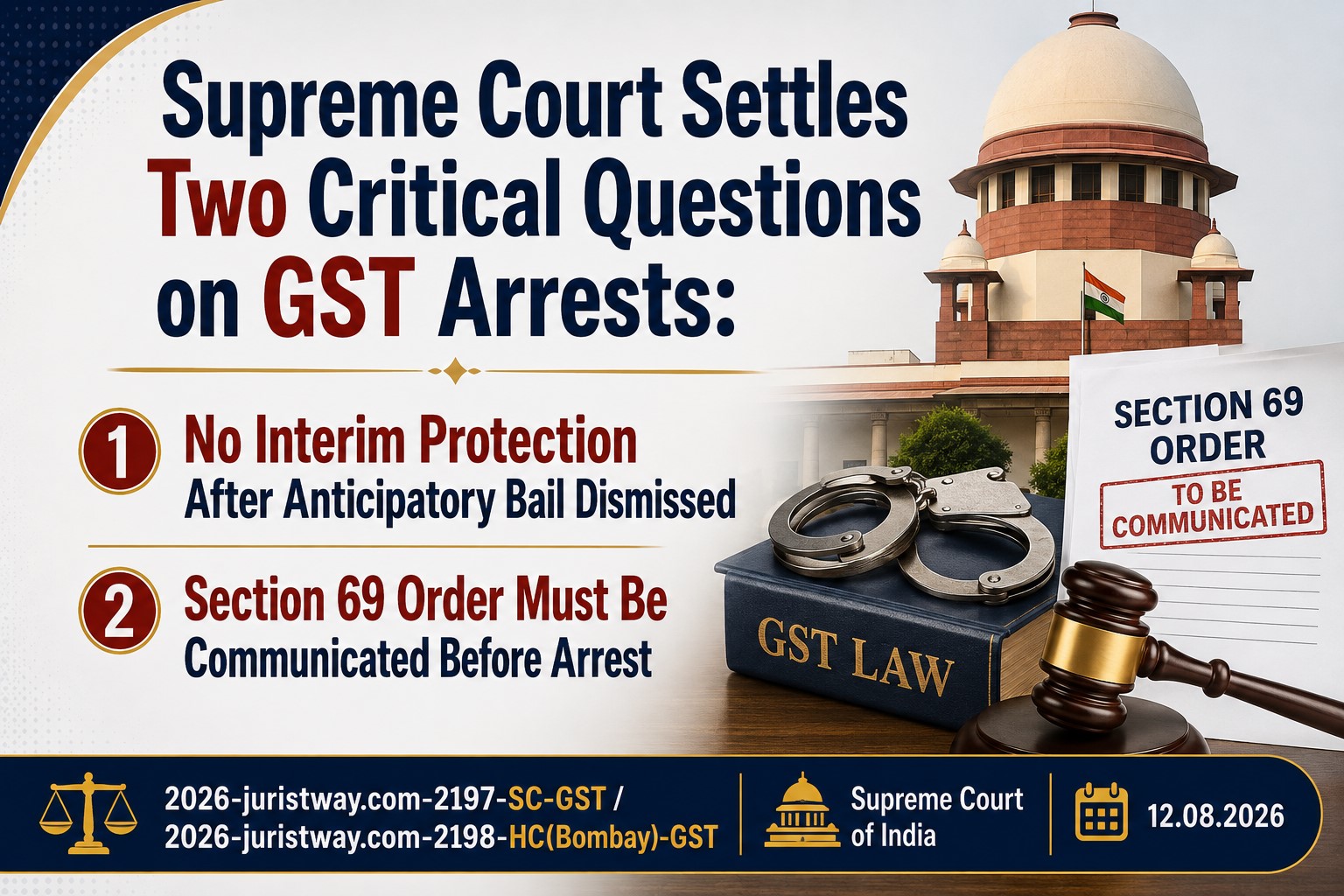
The Supreme Court has used a GST investigation case to resolve two important questions of law concerning arrest powers under the CGST Act — and in doing so has simultaneously reinforced personal liberty protections and curtailed what it describes as an impermissible practice of high courts granting protective interim orders after rejecting anticipatory bail applications. The judgment, delivered by a bench of Justice Dipankar Datta and Justice Sheel Nagu in Union of India v. Sunil Biyani (Criminal Appeal No. 3795/2026, decided 12.08.2026), arises from a Bombay High Court order that had rejected Sunil Biyani's anticipatory bail application but then granted him one week of protection from arrest after the Section 69 order was communicated to him.
The backstory matters. Sunil Biyani was summoned by the DGGI under Section 70 of the CGST Act in connection with an investigation into M/s Alphaneon Techsolutions Pvt. Ltd. and its group entities, alleged to have wrongfully availed and passed ITC without actual supply of goods or services. He applied for anticipatory bail before the Bombay High Court. On 13.02.2026, Justice N.R. Borkar rejected the bail application on the ground that no order under Section 69 had even been passed — so there was no apprehension of arrest and the anticipatory bail application was premature. But the Bombay HC then added a rider: if a Section 69 order were passed, Biyani would not be arrested for one week from the date of communication of such order. Union of India challenged this protective rider before the Supreme Court.
On the first question — whether a court can grant protection from arrest after dismissing an anticipatory bail application — the Supreme Court set aside the Bombay HC's protective rider unequivocally. The principle, tracing back to a five-judge bench ruling in State of Orissa v. Madan Gopal Rungta (1951) and reiterated in Hema Mishra v. State of U.P. (2014), is that an interim relief can only be in aid of and ancillary to the main relief. When the main relief (anticipatory bail) is refused — whatever the ground for refusal — no further interim relief can be granted. Once a petition is dismissed, all interim reliefs granted in connection with that petition fall away. The Bombay HC's order granting a protective week was therefore unsustainable, and the Supreme Court so held without qualification.
The second question arose from the respondent's argument: that the Section 69 order (which the Commissioner must pass authorising arrest) should be communicated to the person before arrest, failing which the person has no practical opportunity to challenge it or seek anticipatory bail. The Supreme Court accepted this position and held that communication of the Section 69 order to the person sought to be arrested is mandatory. The reasoning is elegant: the Section 69 order is a sine qua non for seeking anticipatory bail; if the order need not be communicated, the person has no practical means of knowing it has been passed and therefore no opportunity to exercise the right to seek bail before arrest. Reading the statutory scheme alongside the principles in Radhika Agarwal v. Union of India (2025) and Gurbaksh Singh Sibbia v. State of Punjab (1980), the court held that personal liberty cannot be subordinated to an interpretation that withholds from the accused the information needed to protect that liberty.
The practical effect is significant. The Commissioner's order under Section 69 authorising arrest must now be communicated to the person before the arrest is effected. The court noted that Rule 8 of the CGST Rules requires a registrant to provide an email address and mobile number at registration — electronic communication through these channels is permissible in addition to BNSS modes. Only after such communication can the arrest proceed. The investigation, the court clarified, may continue unaffected by this communication requirement; the observations do not touch the merits of the investigation against the respondent.