I. The Core Question: Can an Omitted Restriction Still Block a Live Refund?
GST law taxes domestic consumption, not exports. The zero-rating architecture of Section 16 of the IGST Act, 2017 ensures that exported goods and services leave the country free of embedded tax. Exporters who choose to pay integrated tax at the time of export and thereafter claim its refund under Rule 96 of the CGST Rules, 2017 rely on this foundational commitment. Rule 96(10), however, introduced a carve-out: it denied this refund where the exporter had availed certain exemption or concessional-rate benefits on inputs or input services. The provision generated widespread disputes, with exporters contending that the restriction either lacked proportionality or, in many fact patterns, assumed a “double benefit” that did not actually materialise.
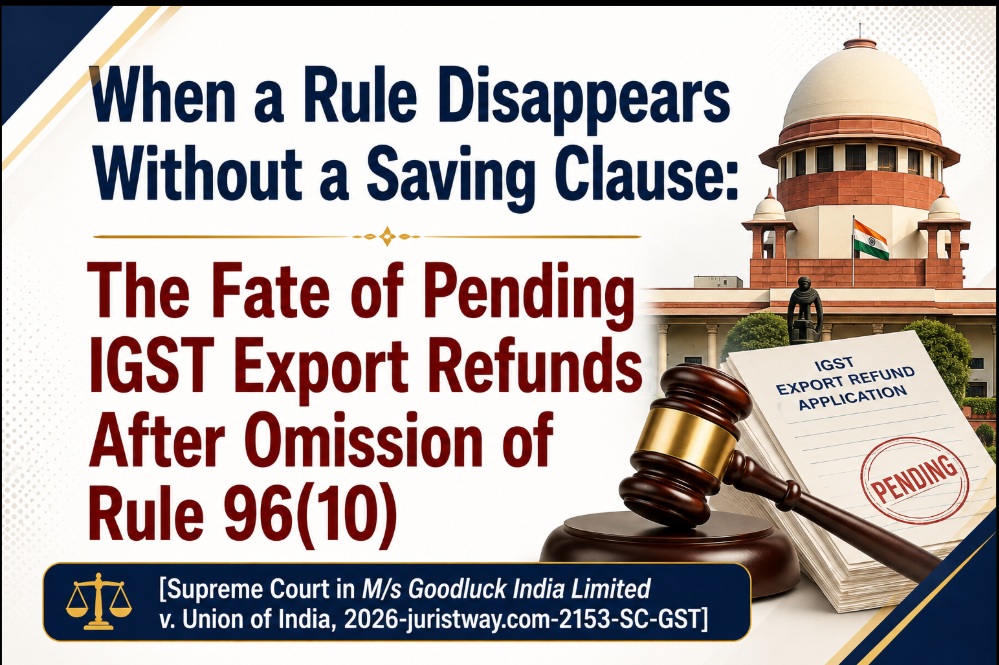
Rule 96(10) was omitted from the statute book by Notification No. 20/2024-Central Tax dated 08.10.2024, following a recommendation of the 54th GST Council meeting (09.09.2024) that the rule—along with Rules 89(4A) and 89(4B)—had produced avoidable administrative complications without achieving its intended objective. The omission, however, left open a critical question: what happens to the hundreds of refund claims, show cause notices, adjudication orders and appeals that were still pending when the rule ceased to exist? The Supreme Court’s recent decision in M/s Goodluck India Limited and Another v. Union of India and Others (2026-juristway.com-2153-SC-GST), affirming the Gujarat High Court’s judgment in the Addwrap Packaging batch, settles that question decisively.
II. The Constitutional Bench Foundation: Kolhapur Canesugar Works
The analytical anchor of the decision is the Constitution Bench ruling in Kolhapur Canesugar Works Ltd. v. Union of India (2000). That judgment drew a sharp distinction between repeal of a statute and omission of a subordinate rule. Section 6 of the General Clauses Act, 1897 operates as a statutory saving clause for repealed Central Acts and Regulations, preserving pending proceedings, accrued rights and incurred liabilities even absent express saving language in the repealing enactment. Subordinate legislation—rules framed under a parent Act—does not enjoy this automatic safety net. When a rule is omitted, its continued operation for pending matters depends entirely on whether the omitting notification contains an express saving clause or a deeming fiction to that effect. If neither exists, the rule simply ceases to apply—to future and pending matters alike.
This distinction is not merely academic. It reflects a structural feature of the Indian legislative scheme: delegated legislation exists at the discretion of the rule-making authority, and that authority’s silence on the transitional treatment of an omitted rule is itself a legislative choice. Courts cannot supply a saving clause that the rule-maker chose not to include.
III. Application to Rule 96(10): No Saving Clause, No Continued Operation
Notification No. 20/2024-Central Tax omitted Rule 96(10) without any accompanying saving or transitional provision. No clause stated that pending proceedings, show cause notices or orders already issued under Rule 96(10) would continue to be governed by the omitted provision. Applying the Kolhapur Canesugar Works framework, the Gujarat High Court in the Addwrap Packaging batch held that the omitted restriction could not be applied to any proceeding that remained pending on the date of omission. The Supreme Court has now endorsed this conclusion.
The Revenue’s principal argument was drawn from the minutes of the 54th GST Council meeting. It contended that the Council’s recommendation contemplated only prospective operation of the omission, and that pending matters should therefore continue to be adjudicated under the old rule. The Supreme Court noted, however, that the GST Council’s recommendations are advisory in character—a position consistent with the Constitution Bench ruling in Union of India v. Mohit Minerals Pvt. Ltd. (2022). The legal consequence of omission must be determined from the notification that gives it effect, not from the background deliberations that preceded it. Since the notification contained no saving clause, the Council’s intent—even if it were as the Revenue characterised it—could not override the legal effect of an unqualified omission.
IV. Scope of the Ruling: Pending Proceedings, Not Concluded Matters
The judgment is careful in its reach. Its benefit extends to proceedings that were still alive on the date Rule 96(10) was omitted: pending refund applications, un-adjudicated show cause notices, orders under challenge in appeal or writ, and any proceeding where the controversy had not attained finality. It does not authorise the reopening of matters that had already reached finality before the omission.
The Revenue had argued before the Gujarat High Court that writ petitions challenging Rule 96(10) should not qualify as “pending proceedings.” This was rejected because those very petitions also challenged specific show cause notices and adjudication orders issued under the rule—the disputes remained live. The Supreme Court’s affirmance carries this reasoning forward. Any matter in which Rule 96(10) was the basis for refund denial and which has not attained finality stands governed by the law as it now exists—that is, without Rule 96(10).
V. Wider Ramifications: Constitutional Challenge, Rules 89(4A)/89(4B) and Direction to High Courts
The exporters had also challenged Rule 96(10) on constitutional grounds—arbitrariness under Article 14, disproportionate restriction under Article 19(1)(g), and ultra vires rule-making under Section 164 of the CGST Act. With the rule omitted and the benefit extended to pending proceedings, neither court found it necessary to adjudicate these questions—consistent with the judicial discipline of avoiding constitutional pronouncements when a narrower statutory ground suffices.
The same principle extends to Rules 89(4A) and 89(4B), which imposed analogous ITC refund restrictions and were omitted by the same notification, again without a saving clause. The Gujarat High Court’s decision in Alstom Transport India Limited v. Union of India and Others confirmed this. Recognising that divergent views had emerged across the country, the Supreme Court also directed its Registry to circulate the order to all High Courts for placement before appropriate Benches—effectively foreclosing any continued reliance on Rule 96(10) in live proceedings nationwide.
VI. Practical Implications
For exporters with pending refund claims or adverse orders: Where refund has been denied solely on the ground of Rule 96(10) and the matter remains pending—whether at the refund-processing stage, in adjudication, in appeal or in writ—the denial cannot sustain. The omitted restriction is no longer available as a basis for refund rejection. Exporters should bring the Supreme Court’s order to the attention of the concerned authority or forum.
For adjudicating and appellate authorities: Pending files must be reviewed to identify whether the refund denial rests on Rule 96(10). If it does, and no independent, legally sustainable ground for denial exists (such as non-fulfilment of export documentation requirements, limitation, unjust enrichment, or other procedural deficiency), the refund claim should be processed. The judgment removes the Rule 96(10) barrier; it does not dispense with lawful scrutiny under other applicable provisions.
For professionals advising exporter clients: The broader takeaway extends beyond Rule 96(10). Whenever a rule under the CGST or SGST framework is omitted, the first question must be whether a saving clause accompanies the omission. If it does not, and the client’s proceeding remains pending, the omitted provision cannot ordinarily be applied against the client. This principle is now settled at the level of the Supreme Court and provides a replicable analytical framework for future omissions in the GST rule architecture.
-[Supreme Court in M/s Goodluck India Limited v. Union of India, 2026-juristway.com-2153-SC-GST]